
By Melinda Jennison
Introduction
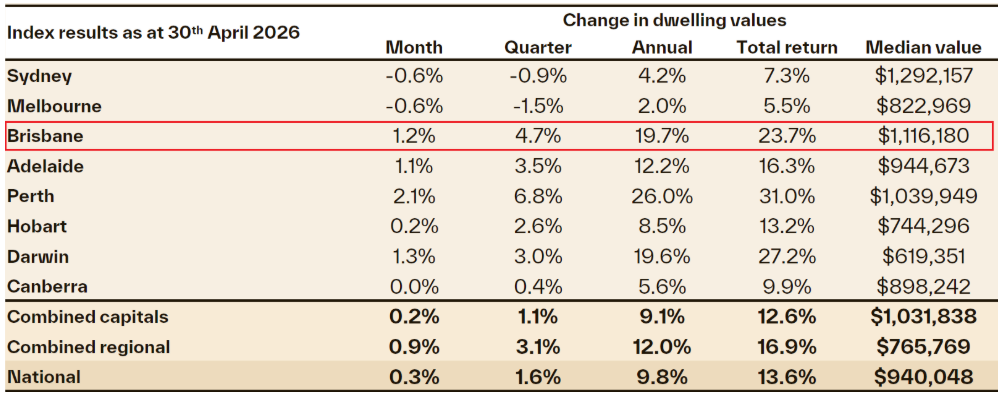
Brisbane’s property market continued to demonstrate resilience in April 2026, recording positive dwelling value growth even as the pace of that growth moderated from the elevated levels observed earlier in the year. According to Cotality’s Home Value Index, Brisbane dwelling values rose 1.2% over the month, a deceleration of 0.6 percentage points relative to March’s 1.8% increase, yet still amongst the strongest monthly performances of any Australian capital city. The national picture is increasingly divergent. Sydney and Melbourne recorded monthly declines of 0.6% each, whilst Brisbane, Adelaide (1.1%), Darwin (1.3%) and Perth (2.1%) continued to advance. Over the quarter, Brisbane’s 4.7% growth compares very favourably with the combined capitals index of just 1.1%, and on an annual basis Brisbane’s 19.7% gain stands well above the national figure of 9.8%.
A moderation in momentum is nonetheless evident. Cotality’s Research Director, Tim Lawless, has noted that affordability and serviceability constraints have been weighing on demand since late 2025, and the additional pressure of rising interest rates – the Reserve Bank of Australia having lifted the cash rate to 4.1% following hikes in both February and March – is beginning to take effect across the market. Consumer confidence has deteriorated sharply, with the Westpac-Melbourne Institute Consumer Sentiment Index falling 12.5% over the month to reach 80.1 points, returning the index near historic lows not seen outside of the 1980s and 1990s recessions or the pandemic period.
Queensland’s population growth story continues to evolve in ways directly relevant to the property market. Net interstate migration into Queensland over the year to September 2025 was recorded at 19,092 persons. This is the smallest volume since June 2017. The 97,705 arrivals over that period were the fewest since June 2016, whilst departures remained relatively steady at 78,613. This moderation in arrivals likely reflects the erosion of Queensland’s affordability advantage following years of exceptional price appreciation. Nevertheless, Queensland continues to attract more interstate arrivals than any other state, and only Victoria, Queensland and Western Australia recorded positive net interstate migration over the period.
Auction clearance rates in Brisbane averaged 55.18% across April, remaining above year-ago levels according to Cotality data. Nationally, clearance rates have held below 55% since the final week of March, the lowest since July 2022, reflecting softening buyer demand across Australia’s major markets, with Brisbane continuing to outperform the national trend.
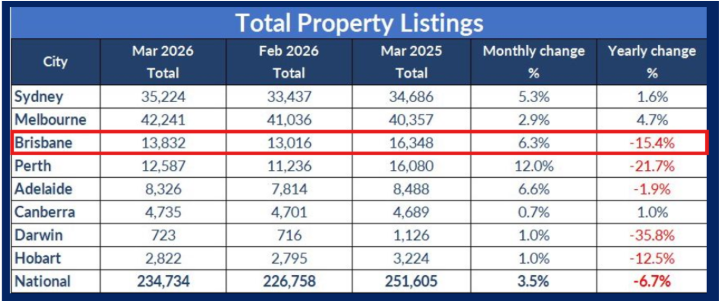
New listing activity in Brisbane showed a modest uplift through March 2026, with SQM Research recording 7,120 new listings for the month. This is a 2.9% rise on February and 3.5% above the same period a year ago, making Brisbane one of the few capital cities to record year-on-year growth in new listing volumes.
Total listings reached 13,832 in March, up 6.3% from February, yet still substantially constrained, sitting 15.4% below March 2025 levels. This pronounced year-on-year decline in total stock continues to underpin price support across the city.
Source: SQM Research
Encouragingly, old listings, that is properties on the market for more than 180 days, fell to 1,446, down 1.6% from February and 18.2% lower than a year ago, suggesting that stale stock is being absorbed effectively and that vendors are broadly achieving outcomes without significant discounting.
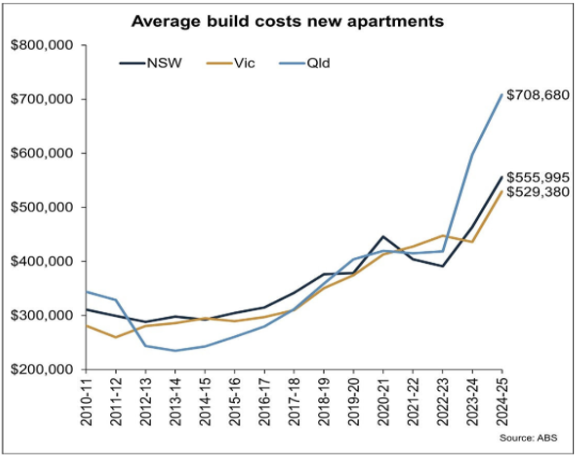
Construction of new dwellings remains under severe pressure. According to the Australian Bureau of Statistics, average residential build costs escalated significantly in 2024–25. New house build costs rose 7.1% over the year nationally, townhouse costs increased 18.8%, and new apartment build costs rose 18.2%. In Queensland specifically, house construction costs rose 1.8%, townhouse costs climbed 12.3%, and apartment construction costs surged 18.5%. Most strikingly, the average cost to build a new apartment in Queensland now stands at $708,680, materially higher than in New South Wales ($555,995) or Victoria ($529,380), placing enormous strain on project viability and posing a direct challenge to the Federal Housing Accord’s targets of 1.2 million new homes over five years.
Source: ABS
Brisbane Dwelling Values
Brisbane’s median dwelling value reached $1,116,180 as at 30 April 2026, according to Cotality. Monthly growth of 1.2% represents a moderation from 1.8% in March, and quarterly growth of 4.7% has eased from 5.1% in the prior rolling period. On an annual basis, however, Brisbane’s 19.7% gain represents an acceleration from the 19.0% recorded to the end of March, reflecting the strong trajectory established throughout 2025 and into 2026.
Source: Cotality
Over ten years, Brisbane dwelling values have risen 119.5% – the highest rate of appreciation across all Australian capital city markets. PropTrack data corroborates the positive direction, recording monthly price growth of 0.2% through April.
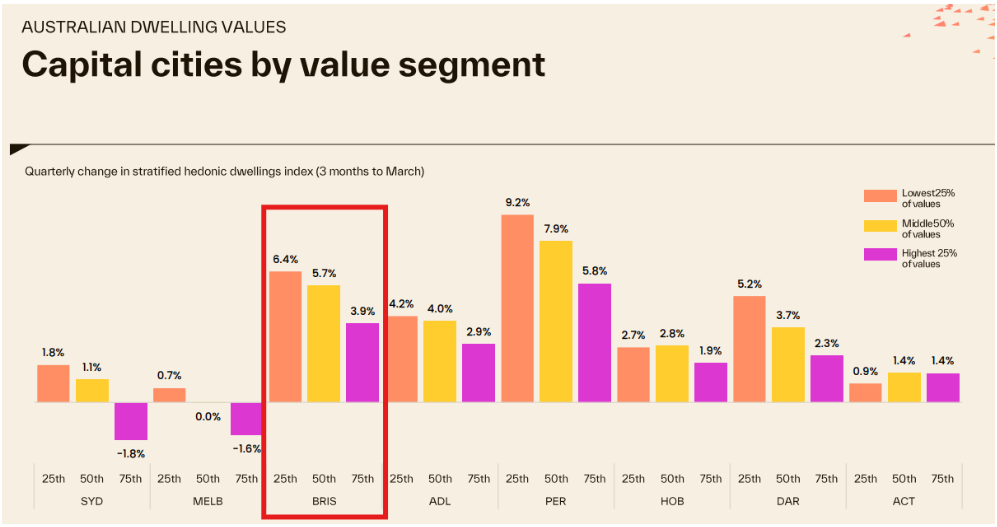
Analysis by market segment reveals a nuanced and encouraging picture. The Cotality stratified hedonic index for the three months to April shows Brisbane’s lower quartile recording quarterly growth of 6.4%, the middle 50% growing 5.7%, and the upper quartile advancing 3.9%. Comparing this with the March data, where the lower quartile recorded 6.4%, the middle 50% grew 5.5%, and the upper quartile grew 3.4%, growth across the middle and upper segments has actually firmed modestly month-on-month, even as the headline monthly rate has softened. This suggests that whilst affordability-driven demand continues to support the entry-level market strongly, the middle and upper segments are showing signs of more growth momentum. This is a reassuring signal given the broader headwinds at play.
Source: Cotality
Brisbane House Values
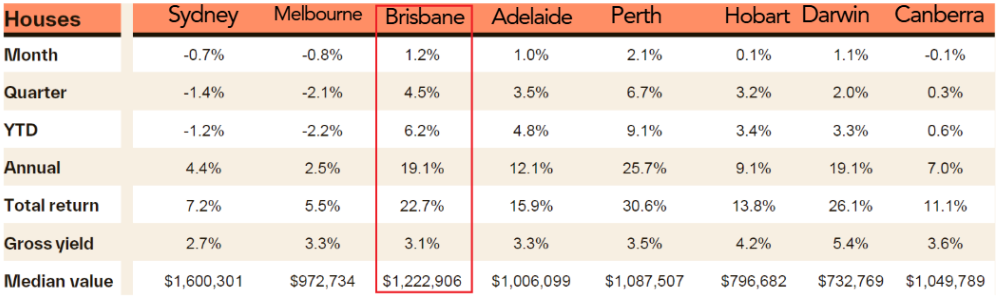
Brisbane’s median house value reached $1,222,906 in April 2026, rising from $1,207,718 in March. Monthly growth of 1.2% represents a deceleration of 0.5 percentage points from March’s 1.7%, and quarterly growth of 4.5% has eased from 4.9% in the prior rolling period. On an annual basis, however, house value growth of 19.1% has accelerated from 18.5% recorded to end of March which is a positive trend for owners and investors alike.
Source: Cotality
Brisbane’s house value performance continues to significantly outpace the combined capitals annual average of 9.9%, and stands well ahead of Adelaide (12.1%), Sydney (4.4%) and Melbourne (2.5%).
PropTrack data similarly records 0.2% house price growth across Brisbane in April, consistent in direction with Cotality’s findings.
Brisbane Unit Values
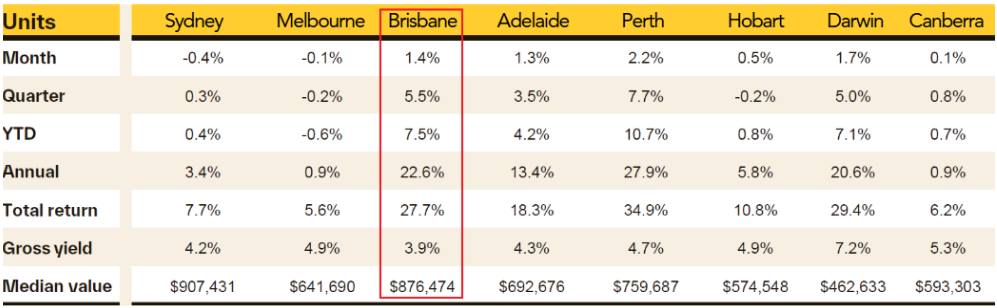
Brisbane’s median unit value rose to $876,474 in April, up from $865,548 in March, reflecting monthly growth of 1.4%. This represents a deceleration from the 2.0% recorded the prior month. Despite this easing, the quarterly figure of 5.5% remains strong, and annual growth of 22.6% has accelerated from 21.5% recorded to March, highlighting the continued strength of underlying demand in Brisbane’s unit sector. PropTrack data records 0.2% unit price growth in Brisbane, consistent with the positive growth trend reported by Cotality and reflecting some deceleration from the prior month.
Source: Cotality
Brisbane’s Rental Market
Brisbane’s rental market remains exceptionally tight. The vacancy rate for Greater Brisbane held at 0.8% in March 2026, unchanged from February and only marginally below the 0.9% recorded a year prior, making it one of the most constrained rental markets in Australia. Nationally, the vacancy rate sits at 1.0%, well below the decade average of 2.5%, and every capital city recorded a rate of 1.8% or lower.
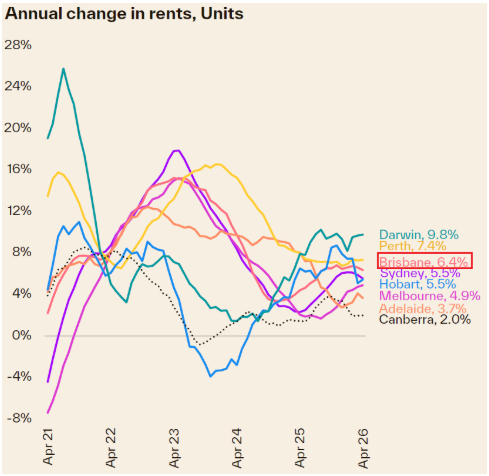
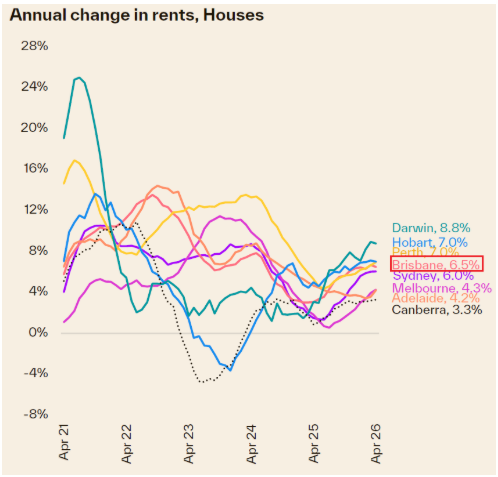
Annual house rent growth in Brisbane came in at 6.5% in April, easing slightly from 6.7% in March, whilst unit rents grew 6.4% annually, also softening from 6.7% the prior month. Whilst both measures have moderated marginally, rental price growth remains well above the rate of general inflation, reflecting the persistent supply-demand imbalance that continues to characterise this market.
Source: CotalitySource: Cotality
 Source: Cotality |
 Source: Cotality |
For comparative context, Darwin recorded the highest annual house rental appreciation nationally at 8.8%, with Brisbane’s 6.5% placing it in the upper tier of capital city markets, well ahead of Melbourne (4.3%), Adelaide (4.2%) and Canberra (3.3%).
Gross yields for Brisbane investors held steady in April, with houses returning 3.1% and units 3.9%, both unchanged from March, reflecting a stable income environment for property investors at present.
Summary
Brisbane’s property market remains one of the strongest performers nationally as 2026 progresses, though the data increasingly points to a controlled moderation in pace rather than any sharp correction. Three key headwinds continue to shape the outlook: rising interest rates, international geopolitical uncertainty, and domestic political uncertainty surrounding proposed tax changes.
Ongoing unrest in the Gulf region continues to weigh on global economic sentiment, placing inflationary pressure on energy prices and supply chains with direct flow-on effects for the Australian economy. Despite periodic ceasefires and the reopening of some airspaces throughout the month, the situation remains volatile and is contributing meaningfully to the sharp deterioration in consumer confidence observed in April.
Adding to investor unease, proposed changes to negative gearing and capital gains tax ahead of the May 2026 Federal Budget have created uncertainty for property investors, who understandably seek clarity on the tax implications of their decisions before committing capital to the market.
Rising interest rates remain perhaps the most immediate concern, with financial markets pricing in at least two further rate increases through 2026. Higher borrowing costs are eroding purchasing power quickly, and this is being felt on the ground. Open home attendances across Brisbane have decreased, and the volume of offers being placed on available properties has softened.
That said, supply-demand imbalances persist, particularly around the median value level and at more affordable price points, where active buyers continue to outnumber sellers. At the prestige end, buyers enjoy greater choice and more time to deliberate, though quality homes continue to attract strong prices with very little discounting observed across the city.
Brisbane’s structural fundamentals, constrained housing supply, sustained population growth, and a decade of exceptional capital appreciation, remain firmly intact. For buyers and investors with a clear long-term outlook, the city continues to present a compelling case even as near-term conditions moderate and the broader economic environment demands a more considered approach.
We hope that you have found our Brisbane Property Market Update April 2026 helpful.
Connect with us today
To book a FREE discovery call ~ Click Here
