
 If you’re looking at property in Albion, Brisbane, you’re looking at one of the city’s most strategically positioned inner suburbs. Located approximately 5 to 6 kilometres north-east of the CBD, Albion sits in a tight pocket where heritage character, strong transport links, and a significant development pipeline all converge. Whether you’re a home buyer chasing proximity to the city or a property investor watching Brisbane’s commercial property options, this Albion suburb profile covers what you need to know.
Key Takeaways
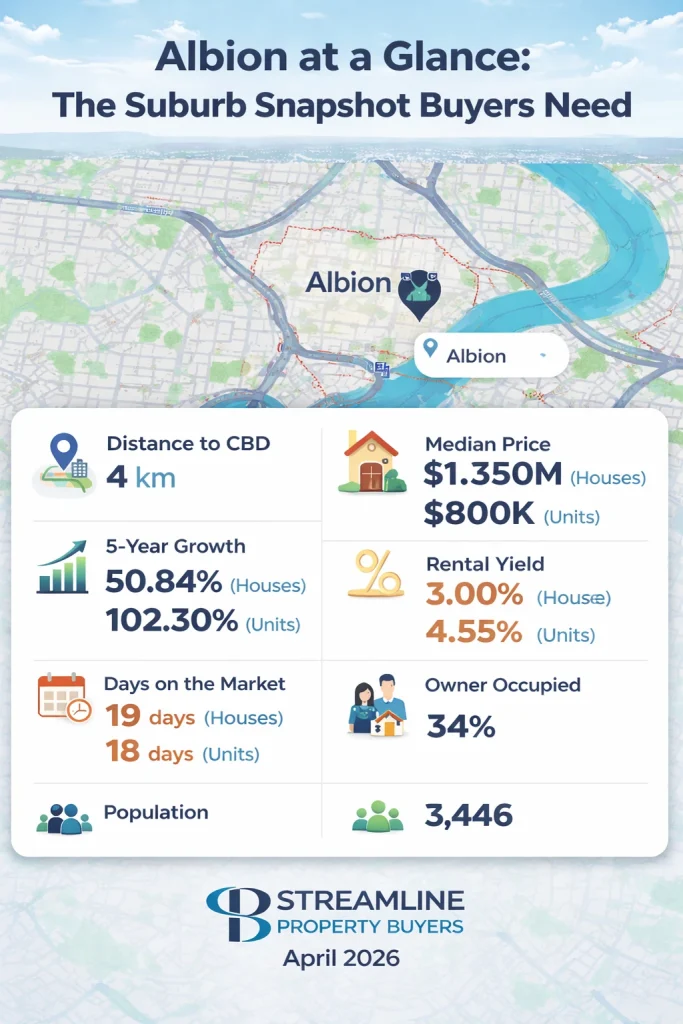
- Location: 4km north-east of Brisbane CBD, postcode 4010.
- Median Dwelling Price: $1,350,000 (April 2026).
- 10-Year Growth: 74% across dwellings.
- Unit Median: $800,100 with 26.00% annual growth.
- Rental Yield (Houses): Approximately 3.00%; median weekly rent $778.
- Vacancy Rate: 1.67%.
- Days on Market: Houses averaging 19 days; units 18 days.
- Population (2021 Census): 3,446, up 50.1% from 2,296 in 2016.
- Transport: Albion Station on five Queensland Rail lines; direct to CBD.
- Schools: No schools within Albion; served by Windsor, Wooloowin, and Eagle Junction State Schools in neighbouring suburbs.
- Major Development: $1 billion Albion Exchange transit-oriented development underway (Geon Property).
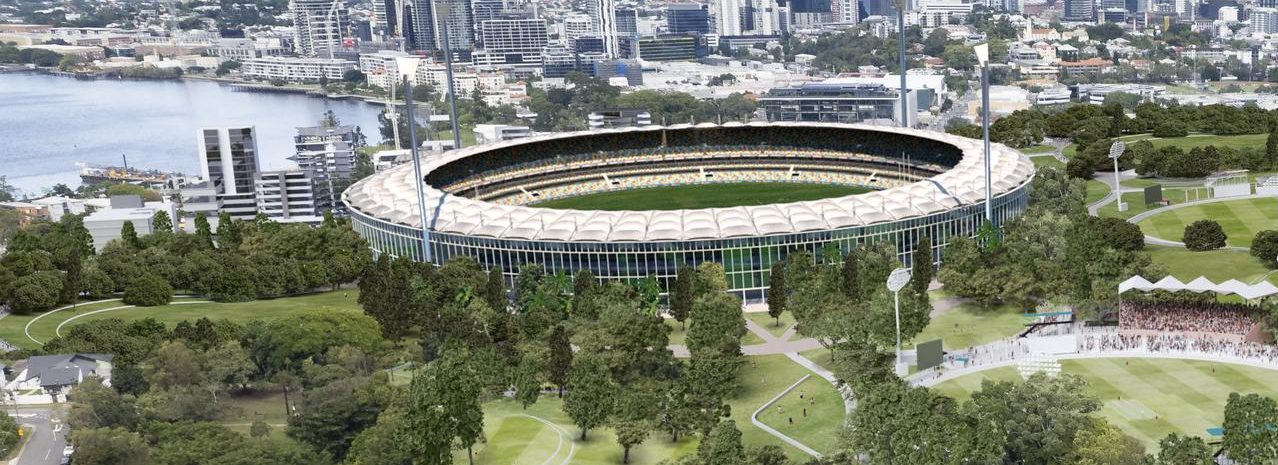
- Olympics 2032: Brisbane Indoor Sports Centre planned for Albion Park Raceway site (Ascot News).
Geography and Character
Albion covers approximately 1.4 square kilometres, making it one of Brisbane’s more compact inner suburbs. The suburb is bordered by Wooloowin to the north, Clayfield to the north-east, Bowen Hills to the south, and Windsor to the west.
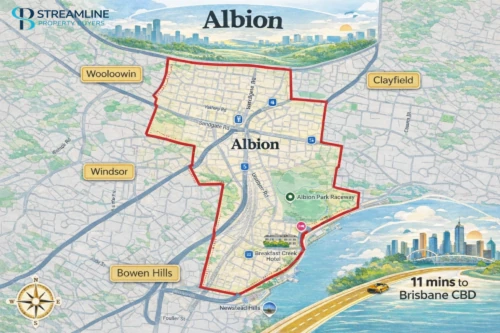
Sandgate Road runs through the middle of Albion, forming the main spine connecting the suburb to the CBD and to Brisbane’s northern arterials. The suburb has a notable mix of residential pockets and commercial or industrial zoned land, which means character varies depending on which part of Albion you’re in.
The elevated northern sections, in particular, are where you’ll find character homes with city views and wider streets. The lower-lying sections closer to Sandgate Road and the station have a more mixed-use feel, and some pockets are undergoing active rezoning and redevelopment.
Albion was named in 1862 after the original Albion Hotel built by Thomas Hayseldon. The suburb retains a collection of heritage-listed sites across both the Brisbane Heritage Register and the Queensland Heritage Register, including the Abbotsford Road Bridge and the Albion Hotel. That heritage layer gives parts of Albion a character that newer growth corridors simply can’t replicate.
Transport
Transport access is one of Albion’s genuine strengths. Albion Station sits on five Queensland Rail lines: the Airport, Doomben, Caboolture, Shorncliffe, and Sunshine Coast lines. That makes it one of Brisbane’s better-connected suburban rail stations, with trains running to Roma Street and Central in three stops.
By road, Sandgate Road connects directly to the CBD, and the nearby Airport Link Tunnel gives residents access to the northern arterials and Brisbane Airport without navigating inner-city congestion.
Translink bus routes also service the suburb. For journey planning and timetables, visit translink.com.au.
Education
Child Care Centres
There are no child care centres currently recorded within the Albion QLD 4010 suburb boundary in the SuburbsFinder database. Families with young children are advised to check the Brisbane City Council website and surrounding suburbs including Wooloowin, Windsor, and Bowen Hills for nearby early childhood education options.
There are no schools physically located within Albion. Families need to consider the nearby school catchments carefully before purchasing.
Nearest government primary schools include:
| School | Suburb | Notes |
|---|---|---|
| Windsor State School | Windsor | Western boundary |
| Wooloowin State School | Wooloowin | Northern boundary |
| Eagle Junction State School | Clayfield | North-east; highly regarded |
| Ascot State School | Ascot | East; strong demand |
For high school, families typically look to Kedron State High School or Fortitude Valley State Secondary College. Always verify the catchment for a specific address using the Queensland Government school catchment search tool before purchasing.
Amenities and Lifestyle
Albion’s lifestyle credentials have strengthened considerably as the suburb has gentrified. The Albion Village dining precinct on Sandgate Road offers cafes, restaurants, and bar options that draw residents and visitors from the surrounding suburbs. The Breakfast Creek Hotel, one of Brisbane’s most iconic heritage pubs, sits just over the southern boundary and is effectively part of the Albion lifestyle experience.

For day-to-day convenience, residents have easy access to Wooloowin and Windsor Village for local groceries, and the Westfield Chermside or Newmarket Village options are a short drive. Major supermarkets are within a 5 to 10 minute drive.
Green space includes:
- Windsor Park (over the western boundary).
- Crosby Park (within Albion).
- Kedron Brook bikeway corridor, connecting north through Wooloowin.
- Abbotsford Road Bridge park and creek reserve.
The median household income in Albion was $1,971 per week at the 2021 Census, a 13.15% increase on 2016. The predominant age group is 20–29 years, with a significant professional population and a growing cohort of young families. Owner-occupier rates sat at approximately 79.6% when adjusted for the high-rise investor skew in the data.

What Type of Properties Are in Albion?
Albion’s housing mix reflects its evolution from a working-class neighbourhood to an increasingly sought-after inner suburb. You’ll find:
- Pre-war workers’ cottages, original timber homes on modest blocks, many now renovated or in the process of being updated.
- Traditional Queenslanders, elevated homes with character features, particularly in the northern elevated pockets.
- Modern townhouses and unit blocks, concentrated near the station and along main roads, with significant new development in the pipeline through Albion Exchange.
- Industrial conversions and commercial properties, particularly in the southern sections closer to Bowen Hills.
The unit market has been the stronger performer in recent data. The median unit price sits at $800,100 with annual growth of 32.25% recorded to December 2025. House prices have moderated after a strong run, with the median sitting at approximately $1,075,000 to $1,160,000 depending on the dataset and period.
The northern elevated pockets are consistently the most desirable for house buyers. These streets offer city views, larger blocks, and the original character that makes Albion different from the surrounding flat suburbs.
Is Albion a Good Suburb to Invest In?
Albion’s Property Market Performance
Albion’s unit market has been one of the standout performers in inner Brisbane over recent months. Annual unit capital growth reached 26.00% to April 2026, with the median unit price sitting at $800,100 and units spending just 18 days on the market. Over five years, unit prices have risen by 102.30% ($404,600), reflecting sustained demand through both the COVID recovery period and the broader southeast Queensland property cycle.
For houses, the median price sits at $1,350,000 with 8.87% annual growth, supported by a rental yield of 3.00% and weekly rents of approximately $778. The five-year capital gain of 50.84% ($455,000) reflects meaningful long-term wealth building potential. Houses currently average 19 days on market, a figure that places Albion well within the high-demand threshold.
| Houses | Units | |
| Median Price | $1,350,000 | $800,100 |
| 3 mo. Change | 11.57% (+$140,000) | 4.59% (+$35,100) |
| 12 mo. Change | 8.87% (+$110,000) | 26.00% (+$165,100) |
| 3-Yr Change | 24.65% (+$267,000) | 68.98% (+$326,600) |
| 5-Yr Change | 50.84% (+$455,000) | 102.30% (+$404,600) |
| 10-Yr Annual Growth (CAGR) | 6.06% | 6.95% |
| 5-Yr Annual Growth (CAGR) | 8.57% | 15.13% |
| Median Rent (per week) | $778 | $700 |
| Sales Days on Market | 19 days | 18 days |
| Gross Rental Yield | 3.00% | 4.55% |
Days on Market
Days on Market is a leading indicator of buyer competition. A lower figure means properties are being snapped up quickly, signalling strong demand relative to supply. The benchmark to watch is 90 days. Properties sitting longer than this tend to attract buyer scepticism. Albion is comfortably below this threshold for both property types.
| Days on Market | Houses | Units |
| Current | 19 days | 18 days |
| 3 mo. Change | +35.71% (+5 days) | -14.29% (-3 days) |
| 12 mo. Change | +18.75% (+3 days) | +63.64% (+7 days) |
| 3-Yr Change | +18.75% (+3 days) | -40.00% (-12 days) |
| 5-Yr Change | No Data | -82.52% (-85 days) |
The unit market tells a compelling story when viewed over five years. Units that previously took over 100 days to sell are now clearing in 18 days, a structural compression that reflects how significantly buyer demand has caught up with this market. House days on market have edged up slightly in the short term from post-COVID lows but remain well within healthy territory.
Rental Yield
Rental yield is the estimated gross rental return, calculated by dividing annual rent by the median price. Yields typically compress as prices rise, so a declining yield is not necessarily a negative sign. It often reflects strong capital growth outpacing rental increases.
| Rental Yield | Houses | Units |
| Current | 3.00% | 4.55% |
| 3 mo. Change | -10.18% (-0.34%) | -1.52% (-0.07%) |
| 12 mo. Change | -4.76% (-0.15%) | -5.80% (-0.28%) |
| 3-Yr Change | -3.85% (-0.12%) | -17.12% (-0.94%) |
| 5-Yr Change | -6.25% (-0.20%) | -17.57% (-0.97%) |
Unit yields at 4.55% are solid for an inner-ring Brisbane suburb, particularly given the 102.30% capital growth achieved over five years. House yields at 3.00% reflect the higher entry price point, though the trade-off is meaningful long-term capital appreciation. Median rent has grown across both segments, with houses up 41.45% over five years to $778 per week and units up 66.67% to $700 per week, indicating that rental demand is keeping pace with the broader property cycle.
Key Investment Signals at a Glance
- Vacancy rate of 1.67%, below the 2% threshold that typically indicates high rental demand.
- Stock on Market (SOM%) at 0.92%, well below the 2% caution level.
- Potential buyers demand up 178.16% over five years, confirming growing market interest.
- 64 development applications logged in the suburb recently, indicating continued transition and improvement activity.
- The $1 billion Albion Exchange transit-oriented development has received Brisbane City Council approval and is actively progressing.
- A 12,000-seat Brisbane Indoor Sports Centre planned for the Albion Park Paceway site, with construction proposed between 2026 and 2028, brings concrete infrastructure investment ahead of the 2032 Olympics.
On location, very few Brisbane suburbs offer a 4km CBD radius, a train station served by five lines, and character housing stock at this price point. The suburb’s investment case rests on location, tight supply, and a significant development pipeline that will reshape the area around Albion Station over the coming decade. Albion functions more as a capital growth story than a pure yield play, which is typical for this price bracket in inner Brisbane.
Demographics
Albion’s population was 3,446 at the 2021 Census, up from 2,296 in 2016, a rise of 50.1% over five years. The suburb spans 1.31 km² and sits just 4 km from the Brisbane CBD. The largest age group is 20 to 29 year olds. The median weekly household income was $1,972 in 2021, reflecting the suburb’s predominantly professional demographic. The top three occupations are Professionals (34%), Clerical and Administrative Workers (14%), and Managers (14%).
The tenure split at the 2021 Census shows 34% owner-occupiers and 66% renters, consistent with a high-density inner suburb where apartment stock is predominant. The average number of people per household sits at 1.9.
Key Demographics Over Time
| 2006 | 2011 | 2016 | 2021 | |
| Population | 1,941 | 1,986 | 2,296 | 3,446 |
| Median Weekly Household Income | $1,073 | $1,493 | $1,724 | $1,972 |
| Median Monthly Mortgage Repayments | $1,517 | $2,104 | $2,000 | $1,950 |
| % Owner Occupier | 42% | 47% | 38% | 34% |
| % Renter | 58% | 53% | 62% | 66% |
| Total Dwellings | 1,057 | 1,050 | 1,302 | 2,057 |
| Avg. People per Household | 2 | 2 | 2 | 1.9 |
The data highlights a suburb in active transformation. Total dwellings have nearly doubled since 2006, driven largely by higher-density apartment development near the station. The shift toward a greater renter proportion over time reflects both the dwelling type mix and the growth of the professional rental market in inner Brisbane.
Which Parts of Albion Are Best to Buy In?
Not all of Albion performs the same. Here’s a practical breakdown:
| Area Type | What to Look For | What to Watch |
|---|---|---|
| Elevated northern pocket | City views, character homes, wide streets | Pays a premium; buy the right block |
| Near Albion Station | Upside from Albion Exchange development | Construction disruption during development |
| Sandgate Road frontage | Good access; some commercial tenancies nearby | Road noise; check zoning overlays |
| Industrial-adjacent pockets | More affordable entry; transition risk | Check planning overlays; some still zoned industrial |
The strongest house prices consistently come from the elevated streets in the northern section. Properties here typically have city views, original character, and larger blocks, all attributes that hold their appeal across market cycles.
Properties adjacent to industrial-zoned land or with rear-lane access to commercial properties need more careful due diligence. The suburb is in transition, and what is industrial-adjacent today may change over the development horizon, but that change also carries planning and construction risk.
Let’s break down Albion’s Zoning.

 |
 |
| This section of Albion to the south is all zoned either Industrial (purple) or high density residential and commercial. there is no low density residential in this section of Albion. | This Section of Albion is the central location. This is where you will find High density unit complexes and commercial/shopping hub. This will be development zone for the Albion Exchange development. |
 |
 |
| This pocket of Albion is where there is medium density residential so some areas have small unit complexes and town homes. there is a lot of character Queensland homes in this area as well that are protected from demolition. The remainder of this section are pre-war homes that are protected from demolition. | This section on Albion is to the north, it is an elevated position with a few streets that achieve city views. Homes that are close to the Train line (yellow) are impacted by the noise. A lot of the homes in this pocket are pre-war and protected from demolition. |
Albion Property Buying Checklist
Before making an offer on any Albion property, work through this:
- Flood and overland flow check. Verify the specific address via the Brisbane City Council flood awareness map.
- Zoning overlay review. Check the Brisbane City Plan for any industrial, medium-density, or development overlays near the property.
- School catchment verification. Confirm the address sits in your preferred catchment at qgso.qld.gov.au/maps/edmap.
- Heritage listing check. Albion has multiple heritage-registered sites; check if the property or street carries heritage protections that affect what you can build.
- Albion Exchange proximity. Properties near the station will see construction activity; understand the staging and timeline before committing.
- Transport noise. The five rail lines through Albion Station can generate noise on properties close to the corridor; inspect at different times of day.
- Building and pest inspection. Original post-war and Queenslander-era homes in Albion often carry subfloor and structural issues that require assessment.
How Streamline Property Buyers Helps You Navigate Your Albion Property Purchase
Albion is a suburb where the right pocket, the right property type, and the right price point make a genuine difference to long-term outcomes. The gap between a poorly located unit near an industrial boundary and an elevated character home with city views can be significant, and the best properties in Albion move quickly given the tight supply and rising buyer interest.
At Streamline Property Buyers, I work exclusively for buyers, not sellers, not developers. That means access to both on-market and off-market opportunities, commercial property options, independent negotiation on your behalf, and the due diligence that protects your decision from the risks specific to a suburb like Albion.
If you’re considering buying in Albion Brisbane, whether as a home buyer or as a property investor, our team would be glad to help you approach it clearly.
Albion QLD 4010 | Data as at April 2026
Property data sourced from SuburbsFinder Ltd (ABN 34 687 487 921) on behalf of PropTrack Pty Ltd (ABN 43 127 386 298), April 2026. Demographics data from the Australian Bureau of Statistics, 2021 Census. This profile is provided for general information purposes only and does not constitute financial, investment, or legal advice. Past performance is not indicative of future results. Users should conduct their own independent due diligence before making property decisions.
Connect with us today
To book a FREE discovery call ~ Click Here
Follow us on LinkedIn | YouTube | Instagram | TikTok
Tune into our podcast ~ Brisbane Property Podcast
