
Most buyers have a rough idea that property prices go up over time. Fewer can explain why. And that gap in understanding often leads to costly decisions, like buying a high-rise apartment in a saturated market, or chasing a shiny new build when the land content barely registers.
Property value is not random. It follows patterns driven by real estate property value fundamentals that experienced buyers know well. Once you understand those drivers, buying decisions get a lot clearer.
Here is what actually causes real estate to rise in value, with a focus on the Brisbane market.
Land Appreciation vs Building Depreciation: The Core Principle
Every property has two parts: the land it sits on, and the building on top. How each one moves over time is where most buyers get tripped up.
Land appreciates. Buildings depreciate. Full stop.
A dwelling wears out. Roofs fail, plumbing ages, kitchens date. From the day you settle, the building is losing value. The land beneath it faces no such pressure. If demand for that location grows and supply stays fixed, the land becomes worth more, not less.
Land appreciation is the primary engine of capital growth property gains over time. A well-located Brisbane block worth $400,000 a decade ago may have doubled in value, not because of anything done to it, but because of what grew around it.
Properties with a higher land-to-total-value ratio tend to outperform those where the building dominates the purchase price. Scarcity of land is the key mechanism: once a suburb is fully developed, you cannot create more of it.
Land vs Building: At a Glance
| Component | Land | Building |
|---|---|---|
| Supply | Finite in established suburbs | Less limited (can build more) |
| Depreciation | Does not depreciate | Begins depreciating from construction completion |
| Value Driver | Location scarcity | Condition and finishes |
| Long-Term Growth Impact | Primary capital growth engine | Minimal long-term growth |
| Investor Risk | Low (if well-located) | Higher (oversupply risk) |
The New Build Problem
New properties carry a building premium. You are paying for fresh finishes and new appliances, not land. Many house-and-land packages in Brisbane’s outer corridors have small land components priced in. Once the shine fades, building depreciation can outpace whatever land appreciation exists in that location.
In my experience, this catches first-time investors off guard more than anything else. The depreciation tax offset is attractive, but it does not compensate for buying an asset that stagnates in real terms because the land component is too thin.
What Are the Key Factors That Drive Property Value Growth?
Land appreciation does not happen in isolation. Several forces shape where and when real estate property value moves.
1. Property Supply and Demand
When more buyers compete for fewer properties, prices rise. When stock accumulates and buyers pull back, they soften. Brisbane sits firmly in the first camp right now.
Advertised stock is running roughly 25% below the five-year average. Queensland’s population grew 2.3% in the 12 months to June 2024, above the national 2.1%. Greater Brisbane added enough residents between 2020 and 2024 to require around 94,000 new dwellings, yet only 88,000 were built (australianpropertyupdate). That structural gap pushed Brisbane’s median house value past $1,000,000 for the first time in 2025.
2. Location Fundamentals
Not all land holds the same appeal. Location fundamentals, the day-to-day liveability and accessibility of a site, shape long-term demand more than almost any other factor. The things I weigh up:
- Proximity to employment hubs, schools, and services
- Access to transport links (train stations, motorways, future rail)
- Lifestyle amenity (parks, restaurants, walkability)
- Zoning and land use regulations that restrict or allow development
A 600sqm block in Paddington behaves differently to one 40km out in a fringe estate. Both might see some growth, but the inner-ring block carries a scarcity premium that the outer corridor simply cannot replicate.
Buyer Location Assessment Checklist
Use this checklist when evaluating a suburb or street. The more boxes you can tick, the stronger the location fundamentals.
- ✅ Within 10km of CBD or major employment hub
- ✅ Walkable to public transport corridor
- ✅ Within a catchment for a high-performing school
- ✅ Low proportion of investor-owned stock
- ✅ Limited future land release
- ✅ Strong owner-occupier appeal
3. Infrastructure Development Impact on Property Values
New infrastructure reshapes how a city moves and who can access what. The infrastructure development impact on property values is measurable, particularly around new rail stations and upgraded motorway links.
Brisbane’s Cross River Rail, Metro network, and 2032 Olympic preparations are opening up suburbs that were previously too disconnected to attract strong owner-occupier demand. That shift in accessibility changes the demand profile for land in those corridors.
That said, buying on an announcement alone carries real risk. What I often see work is buying once a project is funded and construction is underway, not at the rumour stage.
4. Economic Conditions and Interest Rates
Borrowing capacity moves with interest rates. When rates are low and employment is steady, buyers can pay more, and they do. When rates climb, that ceiling drops fast.
Queensland property value growth slowed through 2023 and into 2024 as rate rises compressed what buyers could borrow. It picked up again once the RBA began cutting in early 2025. Brisbane property value growth ran at around 10% annually through 2024, supported by ongoing migration and returning confidence.
Economic conditions set the tempo. They do not change the underlying quality of an asset.
How Do Property Market Cycles Affect Long-Term Value?
Prices do not move in one direction forever. They run, they pause, they correct, and they run again. I have seen buyers treat a flat period as a reason to stay out of the market entirely, then scramble to buy at the top of the next run. That tends to end badly.
The buyers who do best over time are the ones who buy through cycles, not around them. A correction is not a reason to wait; it is often the best buying window you will see for several years.
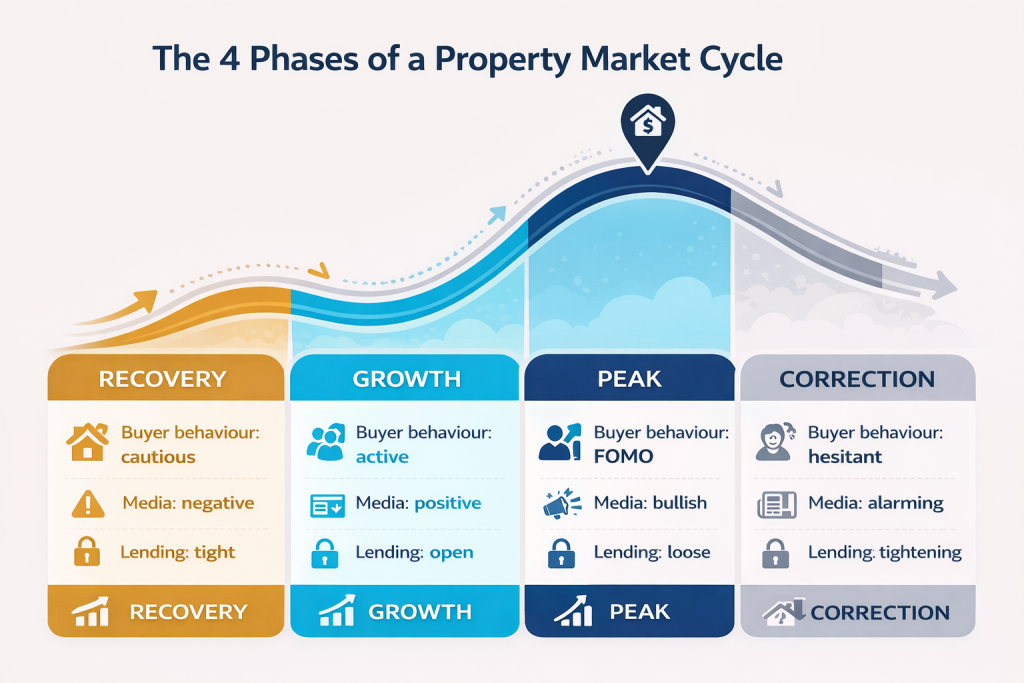
Investment Strategies for each Property Market Phase
| Market Phase | Strategy |
|---|---|
| Recovery | Buy aggressively |
| Growth | Buy selectively |
| Peak | Focus on scarcity |
| Correction | Stay disciplined and acquire for the long-term |
Zoning and Land Use Regulations
What a block of land can legally become shapes what it is worth today. A site with higher-density zoning may attract developer interest at a premium. A suburb locked into low-density residential protects its existing owners from new supply competing with them.
I always pull zoning maps before advising on a purchase. It tells you two things: how much uplift potential exists in the land, and how well protected nearby values are from oversupply. Both matter when assessing real estate property value over a ten-year horizon.
Do the Best Home Improvements to Increase Property Value Actually Work?
Short answer: yes, up to a point. The best home improvements to increase property value, things like a kitchen update, an extra bathroom, or a fresh exterior, can shift a property from the bottom of a suburb’s price range toward the middle. They close a gap.
What they cannot do is push you past the suburb ceiling. Spend $200,000 on a home in a $600,000 median suburb, and you are not walking away with $800,000. The market sets a cap, and no amount of Caesarstone benchtops breaks through it.
The smarter play is buying an older, well-located property with genuine scarcity of land behind it, improving it sensibly, and letting both manufactured and organic value work together. That is how to increase property value without overspending on an asset that will cap out regardless.
Queensland Property Value Growth: What Makes Brisbane Different?
Brisbane’s property market has moved from a “value play relative to Sydney” story to a market with its own structural depth. Queensland property value growth has been among the strongest in the country for five consecutive years. The median house price crossing $1,000,000 in 2025 reflects that shift.
A few things make it different from other Australian markets right now:
- Population growth running above the national average, with strong interstate and overseas migration
- A housing construction shortfall that will take years to close given cost and labour pressures
- $7.1 billion in Olympic infrastructure committed, reshaping liveability and connectivity
- Relative affordability against Sydney that continues drawing buyers and capital north
Westpac, NAB, and ANZ are all projecting Brisbane property value growth in the 4.3% to 4.6% range for 2026. More moderate than recent years, but the fundamentals are intact.
Key Takeaways on Property Value Growth
The core principle has not changed: land appreciates, buildings depreciate. Buy well-located land with genuine scarcity behind it, hold it through property market cycles, and the long-term property investment strategy tends to take care of itself.
The six drivers to keep in mind:
- Land appreciation is the primary source of long-term capital growth property gains
- Property supply and demand set the pace of value movement
- Location fundamentals create lasting demand that scarcity preserves
- Infrastructure development impact on property values is real but timing-sensitive
- Zoning and land use regulations govern both supply risk and development upside
- Property market cycles create buying windows, not reasons to sit on the sidelines
Brisbane ticks a lot of the right boxes right now, but knowing the principles is only half the job. Applying them to a specific purchase requires local knowledge and careful due diligence.
How Streamline Property Buyers Help You Maximise Property Value
Knowing what drives property value and buying correctly are two different things. I see buyers with solid theoretical knowledge still make poor asset selection calls because they are too close to the decision, or because the numbers get dressed up in a way that obscures the land component.
At Streamline Property Buyers, our job is to cut through that. Our team will assess land-to-asset ratios, zoning, local supply and demand, and the infrastructure pipeline before we recommend anything. Whether you are buying a home or building a portfolio, the goal is the same: an asset where Brisbane property value growth potential is real, not assumed.
If you want to run through how these property value drivers apply to your next purchase, book a free discovery call with us today.
Connect with us today
To book a FREE discovery call ~ Click Here
Follow us on LinkedIn | YouTube | Instagram | TikTok
Tune into our podcast ~ Brisbane Property Podcast
