
Brisbane Is Building, and the Numbers Back It Up
Queensland’s 2025-26 transport and infrastructure budget sits at $41.7 billion. That is not a short-term stimulus spend. It is a long-range investment in how this city moves, works, and grows. It is one of the most significant Queensland infrastructure investment pipelines in the state’s history.
For property home-buyers and investors, that kind of capital commitment matters. Major infrastructure projects in Brisbane don’t just ease congestion. They shift the fundamentals of suburb demand, permanently. Better connectivity, improved amenity, urban renewal and precinct development in Brisbane all flow from the same source: sustained, government-backed infrastructure investment.

The question worth asking is not whether Brisbane is changing. It clearly is. The more useful question is: which suburbs stand to benefit most, and why?
To put that $41.7 billion headline in context, here is how the 2025-26 Queensland capital program breaks down across the categories that matter most for property buyers:
| Category | 2025-26 Allocation | Property Relevance |
|---|---|---|
| Transport (roads and rail) | $9.26 billion | Direct suburb uplift: connectivity drives values |
| Health (Hospital Rescue Plan) | $3.67 billion | Employment hubs: proximity supports rental demand |
| Education | $1.07 billion | Family appeal: school catchment desirability |
| Urban Renewal (incl. Northshore Hamilton) | $68.1 million (SEQ precinct works) | Gentrification and precinct uplift |
| 2032 Olympic Delivery Plan | $4.7 billion (total committed) | Long-term demand driver for key corridors |
Sources: Property Council of Australia budget analysis; Queensland Government budget statement

What Are the Major Infrastructure Projects in Brisbane Right Now?
Cross River Rail: Brisbane’s Largest Ever Rail Project
Cross River Rail is a 10.2-kilometre underground rail line running from Dutton Park to Bowen Hills, with 5.9 kilometres of twin tunnels beneath the Brisbane River and the CBD. It delivers four new underground stations at Woolloongabba, Boggo Road, Albert Street and Roma Street, plus upgrades to seven existing stations.
With a revised budget of approximately $7.85 billion and an updated completion timeline now pointing toward 2029, this is the single largest infrastructure megaproject ever undertaken in Queensland. Cost blowouts and timeline revisions are real. I’d be doing you a disservice to pretend otherwise. What’s also real is the permanent transport uplift this project delivers to inner-south Brisbane once it opens.
Suburbs directly in the Cross River Rail corridor:
- Woolloongabba
- Dutton Park
- Boggo Road / Buranda
- Yeronga, Yeerongpilly, Moorooka, Rocklea, Salisbury, Fairfield (south-side station upgrades)
- Bowen Hills
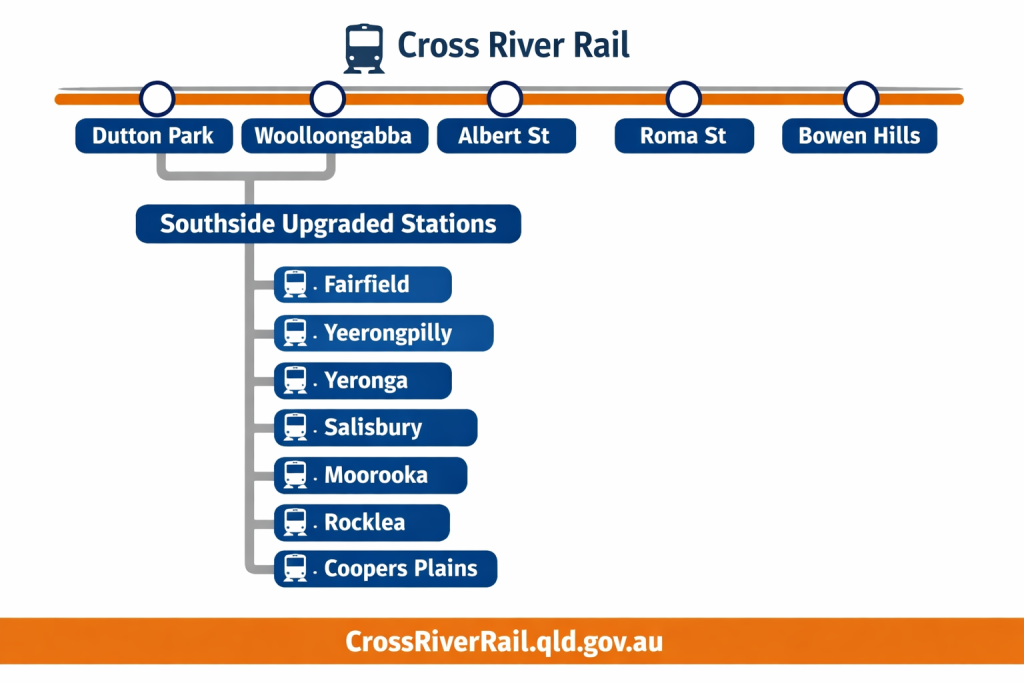
The shift in connectivity for these suburbs is significant. Here is how the key stations compare, pre and post Cross River Rail, using data from the Cross River Rail Delivery Authority.
| Suburb | Current commute to CBD (approx.) | Post-CRR commute | Frequency change | Investment impact |
|---|---|---|---|---|
| Woolloongabba | 15–20 min (bus/walk to CBD) | 3 min to Albert St by rail | Up to 24 trains/hr each direction | High |
| Boggo Road / Buranda | 10–15 min (bus) | Direct underground rail | +22,000 daily boardings by 2036 | High |
| Yeronga | 25 min (surface rail) | Upgraded station, improved frequency | 5 min peak frequency (vs current 15 min+) | Medium-High |
| Fairfield | 25 min (surface rail) | Upgraded station, improved frequency | Improved peak capacity | Medium |
| Exhibition / Herston | 15 min (bus from Valley) | 5 min walk to upgraded station | Direct northern portal connection | Medium-High |
Public transport accessibility and real estate value have a well-documented relationship. Proximity to high-frequency rail consistently supports stronger long-term capital growth and tighter vacancy rates in residential markets.
Brisbane Metro: The Electric Rapid Bus Network
Brisbane Metro launched its high-frequency electric services in 2025, connecting Eight Mile Plains to Roma Street (Line 1) and RBWH Herston to the University of Queensland in St Lucia (Line 2).
This is not just a bus upgrade. The Metro is an all-electric, high-frequency service running every three minutes in peak times, with dedicated busway infrastructure that bypasses general traffic entirely. Brisbane City Council transferred $124 million in Metro assets to Queensland Government entities during 2024-25, with further transfers expected throughout 2025-26 as the project progresses (Queensland Audit Office-pdf).
Future extensions are planned toward Carseldine, Springwood, Capalaba and Brisbane Airport.
Key suburbs with direct Metro access:
- Eight Mile Plains, Upper Mt Gravatt, Mt Gravatt, Nathan
- Holland Park, Greenslopes
- Woolloongabba, West End, South Bank
- Kelvin Grove, Red Hill, Herston
- Dutton Park, St Lucia
The transport corridor property growth impact along this busway is already visible in suburb-level data. Annerley, Highgate Hill and Herston are attracting increased buyer interest as professionals weigh up connectivity against price.
It is worth being clear-eyed about what the Metro does and does not deliver:
| Benefit | Limitation |
|---|---|
| High-frequency service (every 3 min peak) | Limited corridor coverage vs. rail network |
| Dedicated busway: bypasses road traffic entirely | No new rail infrastructure added |
| All-electric fleet, lower emissions | Public perception still lags behind rail in some buyer segments |
| Connects two major hospital/university anchors | Extensions to Carindale/Carseldine remain unconfirmed timing |
Suburb tier ranking by Metro and Cross River Rail combined exposure:
Which Suburbs Should Property Buyers Pay Attention To?
How Does Infrastructure Investment Actually Affect Suburb Growth in Brisbane?
This is the question I get asked most often when clients are weighing up Brisbane suburbs for owner-occupied or investment purchases.
Infrastructure-driven suburb growth in Brisbane follows a fairly predictable pattern. The suburbs that tend to perform best are those where a new project delivers a step-change in accessibility, not just a marginal improvement. Woolloongabba is a good example. It already had reasonable bus links and proximity to the CBD. Cross River Rail adds an underground station connecting directly to the CBD’s southern end, the Gabba, and the Mater health precinct. That is a qualitative shift in connectivity, and the market has started pricing it in.
The Woolloongabba / Buranda / Greenslopes corridor sits at the intersection of Cross River Rail and the Brisbane Metro busway. Both projects reinforce each other here, and the Woolloongabba Precinct renewal strategy adds another layer of urban renewal and precinct development to the mix.
The Herston / Bowen Hills / Kelvin Grove triangle benefits from the Metro’s Line 2 (RBWH to UQ), the Exhibition Station upgrade, and the broader Olympic infrastructure and property demand story. The new Olympic stadium is now confirmed for Victoria Park, placing this corridor even closer to a significant public asset.
The inner south-south-west arc (Yeronga, Yeerongpilly, Moorooka, Fairfield, Salisbury) gains upgraded rail stations via Cross River Rail south-side works. These are affordable entry points compared to Woolloongabba or West End, and they sit on the same rail corridor with the same improved frequency benefits.
What I often see with buyers is a tendency to focus on the headline suburbs and miss the second-tier beneficiaries directly adjacent. Connectivity enhancements boosting local markets rarely stop at the station boundary.
The 2032 Olympics: A Longer-Term Demand Driver
Olympic infrastructure and property demand is a topic worth approaching carefully. Not every suburb near an Olympic venue performs well, and not every prediction about post-Games growth has aged well in other host cities.
What Brisbane is doing differently is integrating Olympic planning into long-term city-building strategy. The venues themselves, from the confirmed Victoria Park stadium to the aquatic centre, are designed as permanent community infrastructure, not temporary structures. Post-Games, these precincts convert into mixed-use community assets with housing, retail, green space and public facilities.
The broader government infrastructure planning in Brisbane for 2032 includes extensions to the Sunshine Coast rail line, Logan and Gold Coast faster rail upgrades, and an ongoing Queensland infrastructure investment pipeline that the 2032 Games accelerated rather than created.
For property buyers with a 7-10 year horizon, government infrastructure planning Brisbane-wide provides a genuine tailwind. For those looking to buy and sell within 2-3 years, I’d be more cautious about attributing too much weight to Olympics-specific demand signals. Buy well in the right corridor, and let the infrastructure work over time.
Queens Wharf, Waterfront Brisbane and Inner-City Amenity
Beyond the transport-focused projects, inner-city amenity is being transformed by Queens Wharf Brisbane (the $3.6 billion integrated resort and precinct development linking the CBD to South Bank), the Waterfront Brisbane precinct development on Eagle Street, and the Kangaroo Point green bridge now open for pedestrians and cyclists.

These are quality-of-life improvements that support suburb desirability in the CBD fringe suburbs (New Farm, Fortitude Valley, South Brisbane, Kangaroo Point) without necessarily generating the same direct connectivity uplift as rail or bus infrastructure. They matter, but they should be one factor among several in any buying decision, not the primary driver.
How Streamline Property Buyers Helps You Buy in the Right Brisbane Infrastructure Corridor
Identifying which suburbs sit in the path of Brisbane’s infrastructure investment pipeline is one part of a good buying decision. The harder work is finding the right property, in the right street, at the right price within those suburbs.
What I find with most buyers is the research phase is not the problem. The problem is translating that research into a confident, well-timed purchase in a competitive market.
At Streamline Property Buyers, we work with home buyers, investors and interstate buyers to do exactly that. Our team know these corridors well, track the precinct strategies and planning changes that don’t always make headlines, and bought in many of the suburbs mentioned in this article for clients over recent years.
If you’re working through a purchase in Brisbane and want a clear-eyed second opinion on how infrastructure factors into a suburb or property decision, book a free discovery call.
Connect with us today
To book a FREE discovery call ~ Click Here
Follow us on LinkedIn | YouTube | Instagram | TikTok
Tune into our podcast ~ Brisbane Property Podcast
