
By Melinda Jennison
Introduction
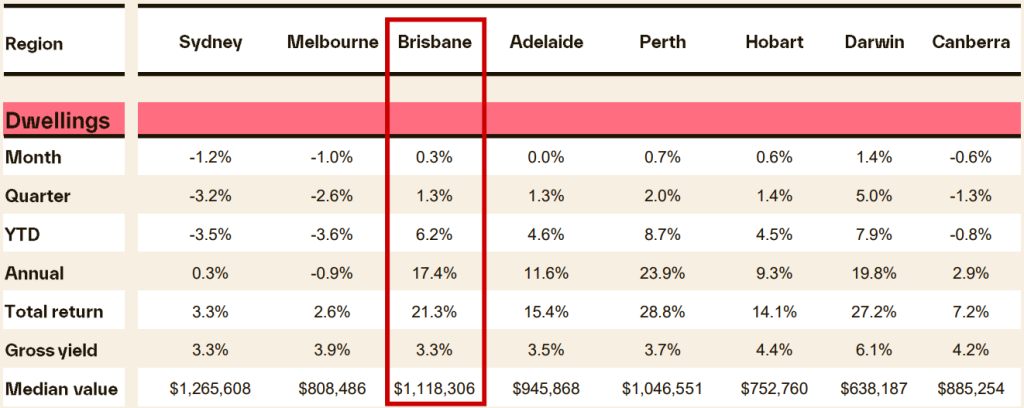
Brisbane’s property market lost further momentum through June 2026, extending a slowdown that has been building since the Federal Budget reshaped investor tax settings and consumer confidence turned sharply negative. Brisbane dwelling values still rose 0.3% over the month, but this was a fraction of the pace recorded earlier in the year, and the city was one of only five capitals to record a monthly gain. Sydney (-1.2%), Melbourne (-1.0%) and Canberra (-0.6%) all recorded outright falls, while Adelaide was flat and Perth (0.7%), Hobart (0.6%) and Darwin (1.4%) posted modest rises.
Nationally, the Cotality Home Value Index fell 0.4% in June, its largest monthly decline since December 2022, with combined capital city values down 1.3% over the quarter. Brisbane’s 17.4% annual growth remains well above the national figure of 7.3% and trails only Perth and Darwin among the capitals, but the trend across every measure is now one of deceleration. The RBA held the cash rate steady in June at 4.35%, providing some breathing space, though the broader mood across Brisbane has clearly shifted from confidence to caution.
The Brisbane market experienced a significant shift in buyer sentiment throughout June. This is primarily a sentiment-driven slowdown rather than one caused by a deterioration in underlying market fundamentals. Consumer confidence weakened substantially following the Federal Budget and changes to tax policy affecting property investors, and negative media coverage and ongoing uncertainty have amplified buyer caution across almost every segment of the market.
Changes to taxation settings have materially impacted investor confidence. Many investors have paused their purchasing decisions while they assess the implications of the proposed changes, while self-managed super fund buyers are fast-tracking decisions ahead of any legislated changes. This has reduced overall buyer numbers and contributed to softer conditions across Brisbane’s established housing market.
Ironically, the very buyers the Federal Government intended to assist are also delaying purchasing decisions. With investors stepping back, first home buyers now have more breathing room and less competition at the entry end of the market. However, many are sitting on the sidelines out of concern that values may fall further. This hesitation appears to be driven more by sentiment than by any genuine improvement, or deterioration, in affordability.
Total advertised listings across Brisbane increased by 13.6% over the past year, a sharp turnaround from the modest decline recorded twelve months ago. This is not primarily because a large volume of new stock is entering the market. New listings grew a comparatively modest 11% annually, well down on the 35.4% pace reported a month earlier, as more sellers hold off listing until conditions firm up. Instead, listings are accumulating because homes are taking longer to sell, with older stock building up as a larger share of total advertised supply.
Current market conditions are highly varied depending on location, property type, presentation, price point and buyer demographic. Well-presented family homes in desirable owner-occupier suburbs continue to sell reasonably well, with some still attracting multiple offers and selling quickly. Properties with tenants in place have become significantly harder to sell, as have properties with compromises such as busy roads, flooding risk or poor presentation. Premium-priced homes are seeing increased choice for buyers, but fewer active purchasers and much longer decision-making timeframes.
Our Brisbane buyers’ agents are observing significant changes in open home attendance. Some inspections now attract only one or two buyer groups, while others still attract more than ten. Three months ago it was common to see thirty to forty groups through quality open homes. This demonstrates that buyer demand has become far less consistent, confidence has reduced considerably, and buyers are becoming much more selective
Auction clearance rates across Brisbane have also fallen sharply. This should not necessarily be interpreted as a collapsing market. Instead, it reflects a widening gap between vendor price expectations and buyer willingness to pay, fewer active buyers competing for each listing, and greater caution among purchasers generally.
The market continues to contend with sticky inflation, uncertainty around future interest rate movements, ongoing cost-of-living pressures and reduced household confidence. These factors continue to weigh on purchasing decisions across every price point.
Consumer confidence has become deeply pessimistic. The Westpac-Melbourne Institute Consumer Sentiment Index fell 2.9% during June, with households reporting renewed pressure on finances and worsening price expectations. This aligns closely with the behavioural changes being observed on the ground across Brisbane.
Although sentiment is weak, buying conditions have improved for well-prepared purchasers. Current advantages include more advertised stock to choose from, longer days on market, greater opportunity to complete thorough due diligence, softer auction competition and stronger negotiating conditions. For buyers with secure employment, sufficient borrowing capacity and strong deposits, this may represent one of the better buying environments seen in recent years.
Brisbane Dwelling Values
Brisbane dwelling values rose just 0.2% in June, according to Cotality data, a sharp step down from the 0.9% recorded in May. The median dwelling value now sits at $1,118,306. Over the past quarter, dwelling values have increased by only 1.3%, down from 3.4% in the prior quarterly reading, while annual growth has eased to 17.4% from 19.1%. PropTrack data told a contradictory story, reporting a monthly dwelling price fall of 0.2% across Brisbane through June, a reminder that different methodologies can produce different signals from the same market.
Source: Cotality
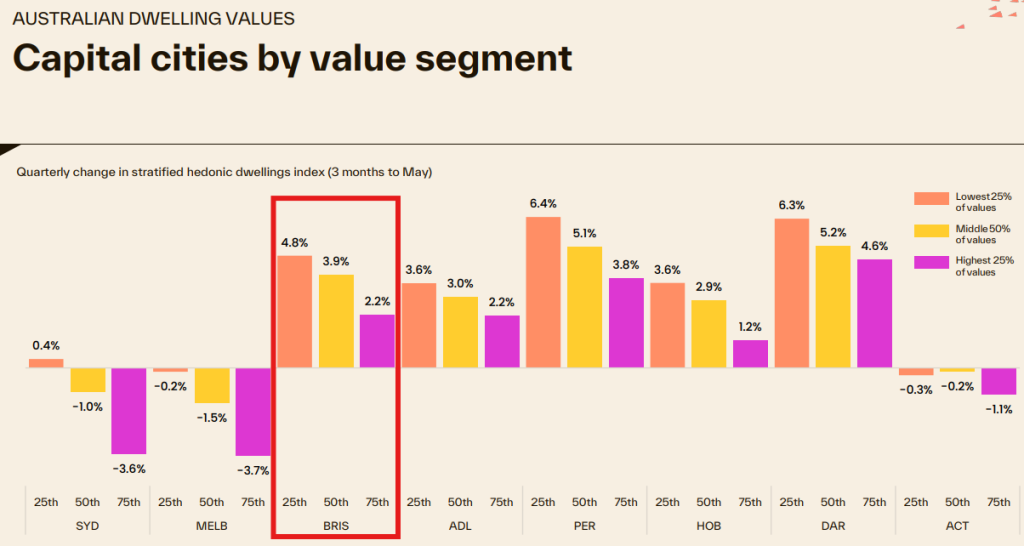
The stratified data confirms the slowdown is broad based. Over the three months to May, growth across Brisbane’s lowest quartile eased to 4.8% from 6.1% the previous month, the middle segment slowed to 3.9% from 5.2%, and the upper quartile softened to 2.2% from 3.5%. More affordable price points continue to lead growth, but the gap is narrowing as momentum fades across every tier.
Source: Cotality
Brisbane House Values
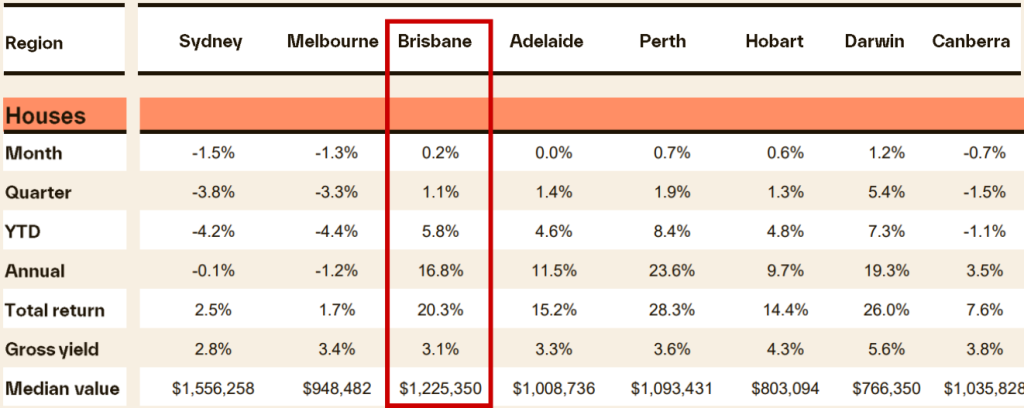
Brisbane house values rose 0.2% in June according to Cotality, with the median house value now at $1,225,350. Quarterly growth eased to 1.1% from 3.3%, while annual growth slowed to 16.8% from 18.6% the previous month. PropTrack again showed a contradictory result, recording a 0.2% monthly fall in Brisbane house prices through June.
Source: Cotality
Brisbane Unit Values
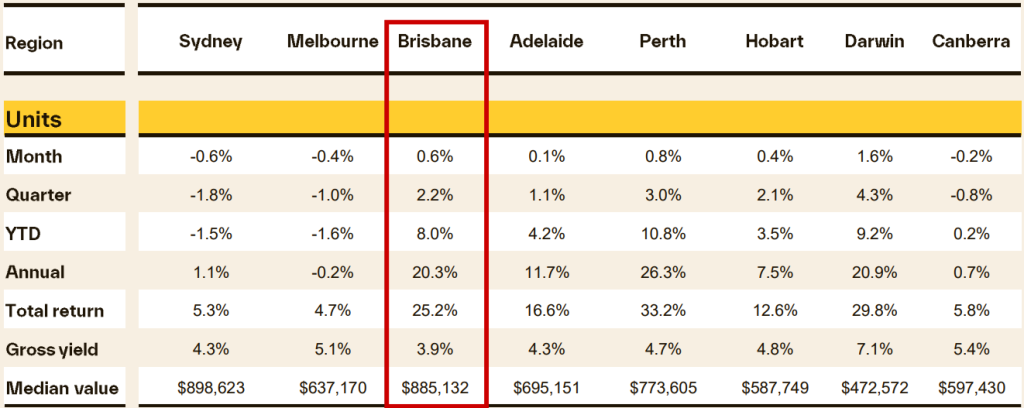
Brisbane’s unit market again outperformed houses in June, with values rising 0.6% to a median of $885,132, only marginally higher than May’s $884,881. Quarterly growth slowed markedly to 2.2% from 4.1%, while annual growth eased to 20.3% from 21.8%, still the strongest of any dwelling type in Brisbane. PropTrack recorded a contradictory monthly fall of 0.1% for Brisbane units in June, though the annual trend from both sources continues to favour units over houses.
Source: Cotality
Brisbane’s Rental Market
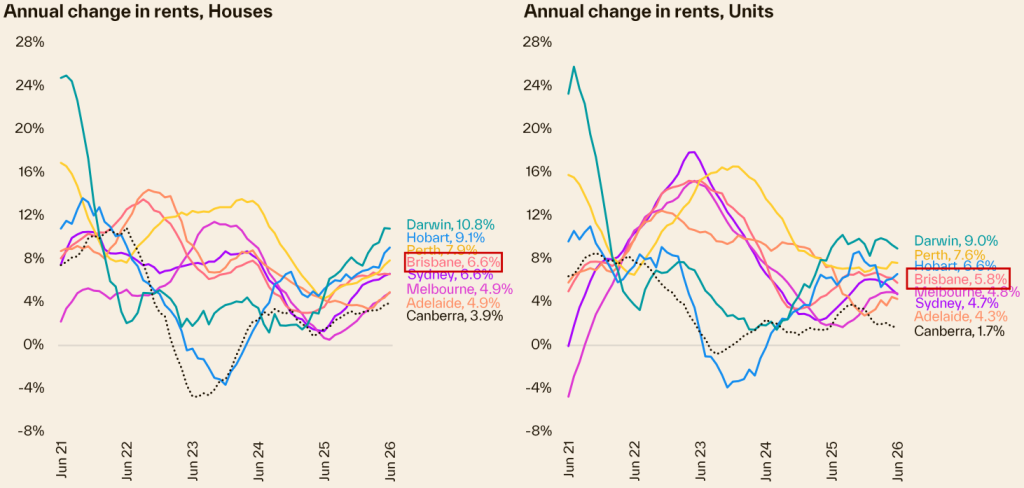
Brisbane’s rental market remains extremely tight, though there are early signs of easing. The vacancy rate for Greater Brisbane rose slightly from 0.8% to 0.9% in June, a modest loosening that nonetheless leaves the city well below the national vacancy rate of 1.6%. Annual house rent growth eased to 6.6% in June from 6.7% in May, while annual unit rent growth slowed to 5.8% from 6.2%, both still comfortably outpacing inflation. Gross rental yields held steady at 3.1% for houses and 3.9% for units, unchanged from the prior month, leaving investor income broadly stable even as capital growth slows.
Source: Cotality
Summary
June 2026 confirms that Brisbane’s property market has entered a more cautious phase, but current conditions should be viewed as a cyclical shift in sentiment rather than evidence that the city’s long-term fundamentals have materially changed. The structural undersupply of housing remains. Brisbane is still not building enough houses and apartments to meet population growth and long-term demand. As confidence eventually returns, competitive conditions could strengthen again.
Looking ahead, reported median values may soften over coming months, but this is more likely to reflect a change in what is selling than a genuine fall in value across the board. With many vendors holding off listing until conditions become clearer, sales are increasingly weighted toward motivated sellers and more affordable stock, and medians will track that shift rather than the fortunes of every property. This should offer some reassurance to owners not currently selling. The market instead rewards prepared buyers, and often creates its best opportunities when sentiment is weakest. Rather than attempting to perfectly time the market, buyers should focus on purchasing the right property when it becomes available, recognising that today’s buying conditions, more stock, less competition and greater negotiating power, may not persist once confidence returns.
We hope that you have found our Brisbane Property Market Update June 2026 helpful.
Connect with us today
To book a FREE discovery call ~ Click Here
