
Airbnb investment has become a genuine alternative to traditional buy-and-hold property in Australia. Domestic travel has grown steadily, and more owners are looking at short-term letting as a way to earn a stronger return from a well-located home or apartment. Whether it makes sense for you depends on three things: location, regulations, and how well the property is managed. This guide covers what Airbnb investment involves, the pros and cons, and how to work out if it’s the right strategy for you.

What Is Airbnb Investment?
Put simply, it’s buying a property with the specific intention of letting it out for short stays rather than signing it up to a long-term tenant. That’s the core difference from a standard investment property, and it changes almost everything about how the property runs.
You’ll often hear this called short term accommodation or short term letting, and the two terms are used fairly interchangeably. A furnished property gets listed on a booking platform and made available to guests, usually for stretches shorter than three months at a time.
A few things set it apart from a typical rental:
- Income arrives as nightly or weekly bookings instead of a fixed monthly rent
- The place needs to be furnished and kept guest-ready, not just liveable
- Turnover is constant, with cleaning between most stays rather than once a year
- Returns can be stronger, but that comes with a heavier workload and higher running costs
Short term accommodation is also the term you’ll see used by state governments and local councils, and it’s worth remembering because it’s this term that determines which planning rules actually apply to your property.
How Does Airbnb Investment Work?
In practice, it comes down to a handful of moving parts. You purchase a property suited to short-term guests, furnish it to a standard that photographs well and holds up to regular use, then list it on a platform such as Airbnb, Stayz or Booking.com. From there it’s ongoing: managing guest bookings and communication, coordinating cleaning between stays, adjusting nightly rates for demand and seasonality, and tracking occupancy so you know how many nights a month the property is actually earning.
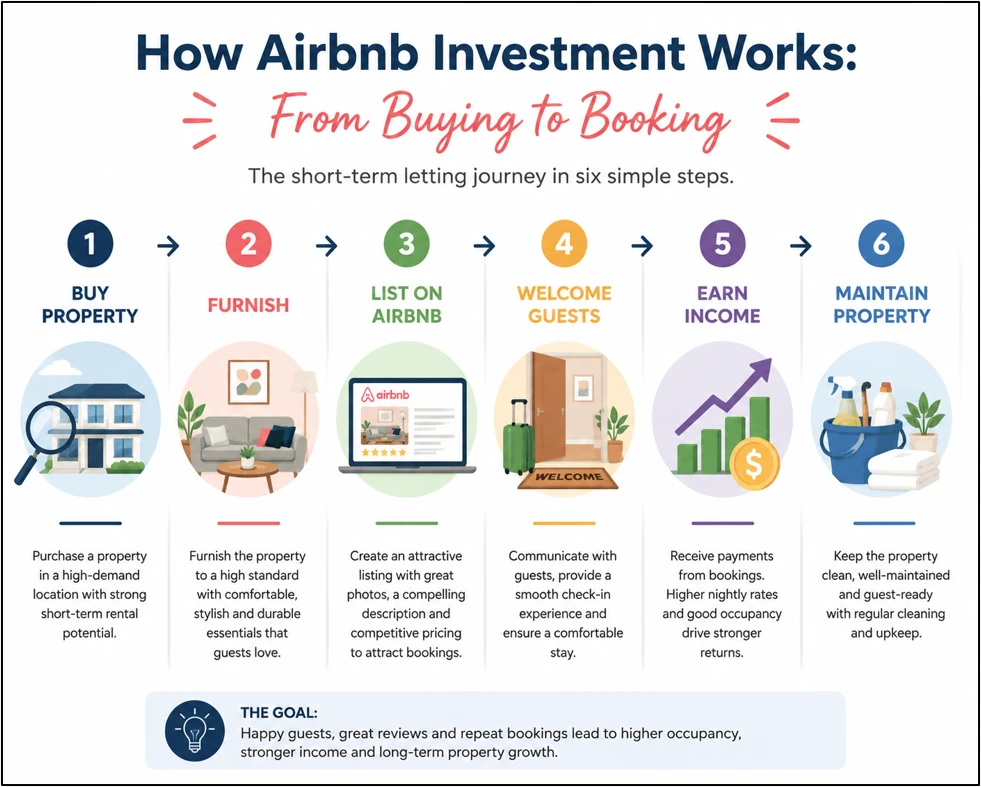
Some owners handle all of this themselves. Others bring in a short-term rental property manager, which lightens the load but comes with a fee that’s typically higher than a standard rental management fee.
Airbnb Investment vs Long-Term Rental
| Factor | Airbnb Investment | Long-Term Rental |
| Rental income | Higher potential, variable | Fixed, predictable |
| Vacancy | Seasonal, harder to predict | Generally low once tenanted |
| Management | Intensive, ongoing | Set-and-forget once leased |
| Maintenance | More frequent, higher wear | Standard wear over lease term |
| Tax | More complex deductions | Simpler deduction structure |
| Flexibility | Owner can block personal use | Limited, tenant has exclusive use |
| Cash flow | Can be stronger in peak periods | Steady month to month |
| Stability | Income can fluctuate | More consistent |
| Time commitment | Significant, unless outsourced | Minimal |
There’s no universally better option here. It depends on the property, the location and how hands-on you want to be.
Is Short-Term Accommodation Legal in Australia?
Short-term letting is legal across Australia, but it’s regulated differently in every state, and it is important to check the rules before you buy rather than after.