
Most buyers come across the term unimproved land value at some point, usually when a council rates notice lands in the letterbox, or during due diligence on a property they are serious about. And most of the time, they are not entirely sure what to make of it.
That is worth fixing. The ULV figure sitting on that notice feeds directly into what you pay in rates and land tax, and it tells you something useful about the land itself, separate from whatever is built on it. Here is how it works and why it matters for home buyers and investors in Brisbane.

What Is Unimproved Land Value?
Unimproved land value (ULV) is the assessed value of a parcel of land in its bare state, no house, no fencing, no earthworks. Just the land as it sits, stripped of anything added to it.
The Land Valuation Act 2010 governs how these assessments work in Queensland. Each year, the Valuer-General issues land valuation notices across selected local government areas, reviewing every rateable property in the state. Sales evidence, land market trends, zoning, and each block’s physical characteristics all feed into that site value assessment.
Factors weighed during a statutory land valuation include:
- Recent comparable sales in the area
- Land zoning and permitted use
- Physical attributes: slope, shape, views, and aspect
- Any restrictions or easements on the land
- Property zoning impact on land value, including flood risk and infrastructure overlays
Those figures then flow through to council rates based on land value and Queensland land tax thresholds. If you own or are buying property in Queensland, knowing how your ULV is calculated gives you a clearer read on what you are actually dealing with.
Visual Summary: ULV vs ICV vs Retail Value
| Feature | ULV | ICV | Retail Value |
| Includes buildings? | No | Yes | Yes |
| Used for council rates? | Yes | No | No |
| Used for land tax? | Yes | No | No |
| Reflects buyer demand? | Limited | Partial | Strong |
| Changes annually? | Yes | No | Market-driven |
How to Find Unimproved Land Value QLD
The Queensland Government runs a free search tool through the Department of Resources where you can pull up the unimproved land value for any rateable property in the state. Head to the link, type in a property address, and the results load instantly.
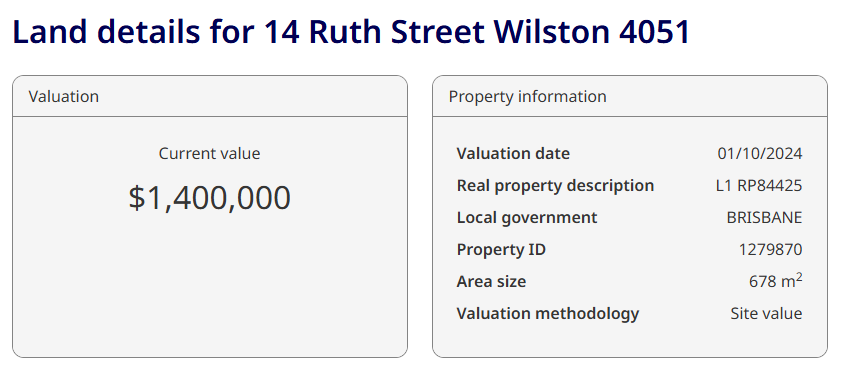
Here is what a typical result looks like. This example shows 14 Ruth Street, Wilston 4051, with a current unimproved land value of $1,400,000 as at 1 October 2024, on a 678m2 block valued using site value methodology.
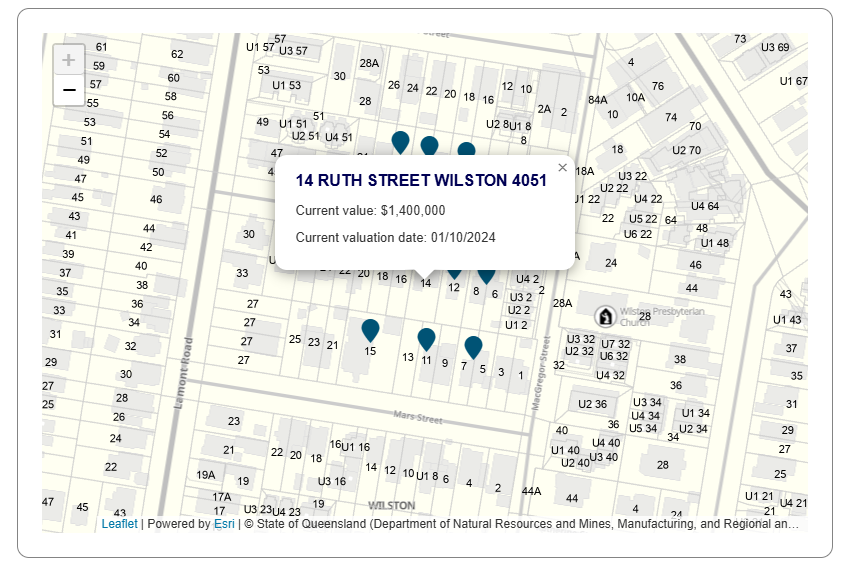
Below the property details, the tool also displays an interactive map showing surrounding properties and their valuation markers. This gives you a quick visual read on how the block sits relative to its immediate neighbours, which is useful when you are comparing land values across a street or a suburb.
Why Do Land Values Differ Between Properties on the Same Street?
This is one of the most common questions I hear from buyers who check their land value and feel puzzled by the result. Two properties sitting side by side can carry quite different unimproved land values, and the reasons are often more nuanced than people expect.
Key reasons include:
- Block shape and size: An irregular block or one with a narrow frontage may be valued lower than a regular rectangular lot of similar area.
- Topography: Steep or heavily sloped land often attracts a lower site value assessment than a flat, build-ready block.
- Views and aspect: Properties with city views or northerly aspects typically record higher statutory land valuations.
- Zoning restrictions: Flood overlays, bushfire zones, or heritage listings can reduce a block’s assessed value.
- Land use classification: Residential vs. commercial zoning will produce very different valuation outcomes.
Case Study: Same Street, Different Values
| Property A | Property B |
| 405m2 flat block | 405m2 sloped block |
| No flood overlay | Minor flood overlay |
| North-facing | South-facing |
| ULV: $520,000 | ULV: $465,000 |
Both blocks are the same size. The $55,000 gap in unimproved land value comes down to three things: sloped topography on Property B adds build cost, the minor flood overlay restricts certain land uses, and south-facing aspect is less desirable in Brisbane’s climate. None of it reflects what is built on the land. It is purely about what the land itself offers.
A lower unimproved land value does not automatically mean a lower sale price. What it can mean is a lower council rates bill, since council rates based on land value are directly tied to the ULV figure. If you are considering an objection to land valuation because you believe the assessed figure does not reflect market conditions, Queensland’s objection process lets you formally dispute the Valuer-General’s notice within 60 days of receiving it.
Unimproved Land Value vs. What You’d Actually Pay: Key Differences
Buyers sometimes assume that the ULV figure for a property is close to what they would pay for the land. It often is not, and understanding why matters.
Unimproved land value is a government-assessed baseline. It is the number used for rating and tax purposes, calculated without reference to what buyers are willing to pay or how hot the market is running.

Retail land value is a separate matter entirely. It is what someone will actually hand over in the open market, shaped by school catchments, proximity to infrastructure, how many buyers are competing for that location, and what has recently sold nearby. It also captures the improved capital value (ICV), which layers in earthworks, fencing, site preparation, and any structures already on the land.
Capital improved value vs land value is a distinction worth understanding clearly:
- ULV: land only, no improvements, used for government rating purposes
- ICV (Improved Capital Value): land plus all improvements, closer to a market valuation
- Retail land value: what the market is prepared to pay, usually higher than ULV and often higher than ICV in strong demand areas
In high-demand Brisbane suburbs, retail land values can sit well above the government’s unimproved land value. That gap is often a reliable indicator of just how competitive buyer demand has become in a given location.
How Does Unimproved Land Value Affect Property Investment Decisions in Brisbane?
This is where ULV becomes genuinely useful for buyers and investors, rather than just a number on a rates notice.

Land-to-Asset Ratio for Property Investors
When I’m assessing a property with an investor client, one of the first things I look at is the land-to-asset ratio. It tells you what share of the purchase price you are paying for the land itself, versus the dwelling sitting on it. Land holds and grows in value over time. The building does the opposite. So when that ratio tilts heavily toward land, you are generally buying something with stronger long-term capital growth potential.
Here is a simple example:
- Unimproved land value: $480,000
- Purchase price: $620,000
- Land-to-asset ratio: ($480,000 / $620,000) x 100 = 77.4%
In my experience, investors targeting Brisbane’s inner and middle rings are often deliberately seeking properties with a high land-to-asset ratio. An older house on a large block close to the CBD can offer more long-term value than a brand-new build in an outer growth corridor, even if the purchase price looks similar. This is especially true in suburbs where zoning supports future redevelopment.
As a general pattern in Brisbane, unimproved land values tend to decrease the further you move from the CBD. Inner-ring suburbs like Paddington, Wooloowin, and Greenslopes carry significantly higher land values than properties in the outer growth corridors. Scarcity of land near the city is one of the core drivers.
Land Tax and Council Rates: How ULV Is Used
Your ULV figure does not just sit on a government database. It has a direct bearing on two things you will be paying as a property owner in Queensland: council rates and land tax.
Each council calculates rates using its own rate-in-the-dollar formula, applied to the ULV figure issued by the Valuer-General. A block with a higher ULV will generate a higher rates bill, regardless of what is built on it or what you paid for it.
Land tax in Queensland works off the total taxable value of all land you own, with your principal place of residence excluded. For individuals, land tax kicks in once that combined figure crosses $600,000, based on the 2024-25 thresholds set by the Queensland Revenue Office.
Got a land valuation notice that does not look right? You can formally dispute it. The Department of Resources runs a structured objection process, with common grounds including an incorrect land size, a misapplied zoning classification, or comparable sales that do not support the figure you have been given.
Should You Lodge an Objection? Checklist
Consider lodging an objection if any of the following apply to your property:
- ✅ Land size is listed incorrectly
- ✅ Zoning has been misclassified
- ✅ Flood overlay has been applied incorrectly
- ✅ Comparable sales used do not reflect current conditions
- ✅ Market downturn since the valuation date is not reflected
Objections must be lodged within 60 days of receiving your land valuation notice. You can submit through the Queensland Government’s objection portal.
How Streamline Property Buyers Can Help You Buy the Right Land, at the Right Price
A ULV figure is a starting point, not a complete picture. What matters more is how you read it alongside everything else: the land-to-asset ratio, local zoning, recent comparable sales, and what is actually driving growth in that pocket of Brisbane.
At Streamline Property Buyers, we work with buyers and investors across Brisbane to do exactly that, assess land value in context, identify investment-grade properties, and cut through the noise in a market where there is plenty of data but not always a clear lens to view it through. Whether it is your first purchase or you are adding to a portfolio, having a professional buyers agent who knows how these numbers fit together can make a real difference to the outcome.
If you would like to talk through your next purchase, book a free discovery call using the link below.
Connect with us today
To book a FREE discovery call ~ Click Here
Follow us on LinkedIn | YouTube | Instagram | TikTok
Tune into our podcast ~ Brisbane Property Podcast
