
Airbnb investment has become a genuine alternative to traditional buy-and-hold property in Australia. Domestic travel has grown steadily, and more owners are looking at short-term letting as a way to earn a stronger return from a well-located home or apartment. Whether it makes sense for you depends on three things: location, regulations, and how well the property is managed. This guide covers what Airbnb investment involves, the pros and cons, and how to work out if it’s the right strategy for you.

What Is Airbnb Investment?
Put simply, it’s buying a property with the specific intention of letting it out for short stays rather than signing it up to a long-term tenant. That’s the core difference from a standard investment property, and it changes almost everything about how the property runs.
You’ll often hear this called short term accommodation or short term letting, and the two terms are used fairly interchangeably. A furnished property gets listed on a booking platform and made available to guests, usually for stretches shorter than three months at a time.
A few things set it apart from a typical rental:
- Income arrives as nightly or weekly bookings instead of a fixed monthly rent
- The place needs to be furnished and kept guest-ready, not just liveable
- Turnover is constant, with cleaning between most stays rather than once a year
- Returns can be stronger, but that comes with a heavier workload and higher running costs
Short term accommodation is also the term you’ll see used by state governments and local councils, and it’s worth remembering because it’s this term that determines which planning rules actually apply to your property.
How Does Airbnb Investment Work?
In practice, it comes down to a handful of moving parts. You purchase a property suited to short-term guests, furnish it to a standard that photographs well and holds up to regular use, then list it on a platform such as Airbnb, Stayz or Booking.com. From there it’s ongoing: managing guest bookings and communication, coordinating cleaning between stays, adjusting nightly rates for demand and seasonality, and tracking occupancy so you know how many nights a month the property is actually earning.
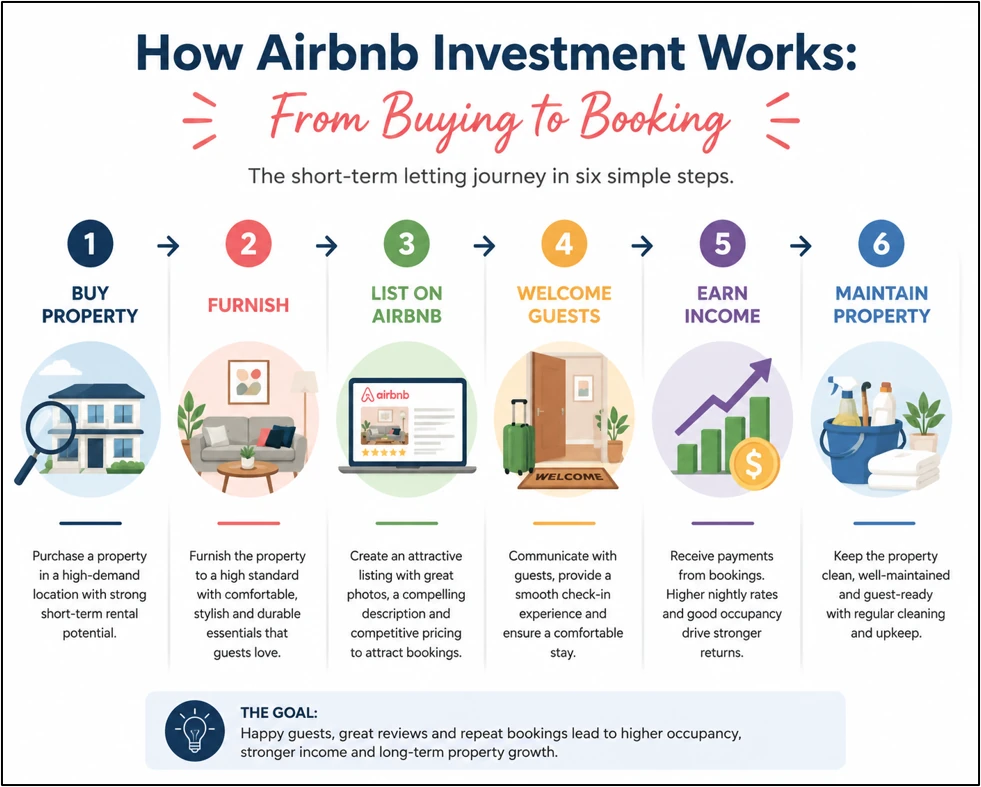
Some owners handle all of this themselves. Others bring in a short-term rental property manager, which lightens the load but comes with a fee that’s typically higher than a standard rental management fee.
Airbnb Investment vs Long-Term Rental
| Factor | Airbnb Investment | Long-Term Rental |
| Rental income | Higher potential, variable | Fixed, predictable |
| Vacancy | Seasonal, harder to predict | Generally low once tenanted |
| Management | Intensive, ongoing | Set-and-forget once leased |
| Maintenance | More frequent, higher wear | Standard wear over lease term |
| Tax | More complex deductions | Simpler deduction structure |
| Flexibility | Owner can block personal use | Limited, tenant has exclusive use |
| Cash flow | Can be stronger in peak periods | Steady month to month |
| Stability | Income can fluctuate | More consistent |
| Time commitment | Significant, unless outsourced | Minimal |
There’s no universally better option here. It depends on the property, the location and how hands-on you want to be.
Is Short-Term Accommodation Legal in Australia?
Short-term letting is legal across Australia, but it’s regulated differently in every state, and it is important to check the rules before you buy rather than after.
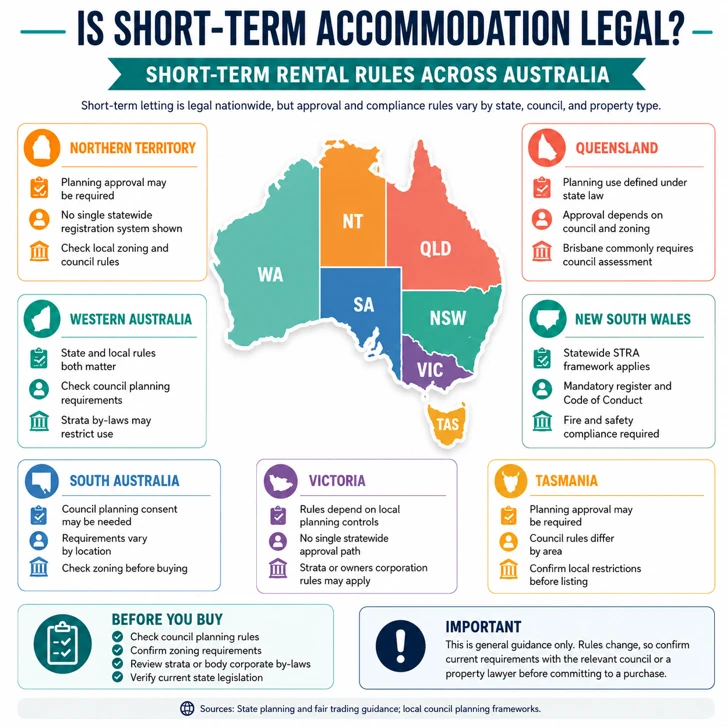
In Queensland, short-term accommodation is a defined planning use under state legislation, and approval requirements depend on the local council and how the property is zoned (Queensland Government, Planning). Brisbane City Council assesses this use through its own planning framework, so before a short-term letting business can begin, owners typically need council approval assessed against the relevant accommodation code (Brisbane City Council).
In New South Wales, short-term rentals sit under a statewide framework, which includes a mandatory code of conduct enforced by Fair Trading and a short-term rental accommodation register managed through the NSW Planning Portal (NSW Government). Properties generally need to be registered before they can be legally let, and hosts must confirm the dwelling meets fire and safety requirements as part of that process (NSW Government, Planning).
Victoria and Western Australia each apply their own local and state-based rules, and body corporate by-laws can further restrict or permit short-term letting within a strata scheme, regardless of what the state or council allows.
Before buying with short-term letting in mind, check local council planning rules, zoning requirements, body corporate by-laws where relevant, and current state legislation.
This is general guidance only. Rules change, so confirm current requirements with the relevant council or a property lawyer before committing to a purchase.
What Makes a Good Airbnb Investment Property?
Location matters more here than for almost any other type of property. The strongest performers sit close to the CBD, beaches, hospitals, universities, events precincts or reliable transport, close enough that a guest doesn’t need a car.

Property type plays a role too, apartments, houses, dual-living setups and dedicated holiday homes can all work, but each pulls in a different guest and comes with its own management demands. Guests consistently gravitate toward off-street parking, reliable Wi-Fi, air conditioning, a pool where there’s one on offer, and a decent outlook.

None of that matters much without genuine local demand behind it. Understanding occupancy trends in a suburb, rather than assuming they’ll be strong, is what separates a considered purchase from a guess.
How to Analyse an Airbnb Investment
A proper analysis goes beyond the purchase price: expected occupancy, achievable nightly rate, gross and net yield, operating costs, realistic cash flow after expenses, vacancy risk in quieter months, and ongoing maintenance all factor in.
Airbnb Investment Quick Check
| Metric | Good Sign | Warning Sign |
| Occupancy Rate | Consistent bookings | High vacancy periods |
| ADR | Strong nightly pricing | Low guest demand |
| RevPAR | Balanced income performance | High price but empty calendar |
| Gross Yield | Strong revenue potential | Income does not justify price |
| Net Yield | Healthy returns after costs | Expenses reduce profits |
| Cash Flow | Positive monthly surplus | Requires ongoing cash injection |
| Break-Even Occupancy | Low occupancy needed | Investment relies on perfect bookings |
Tools such as AirDNA can help estimate occupancy and rate benchmarks for a suburb, but they shouldn’t be the only input. Local knowledge, council rules and a clear view of running costs matter just as much as the data.
Costs to Budget For
| Cost | Notes |
| Mortgage | Core holding cost |
| Council rates | Some councils apply higher rates for short-term properties |
| Insurance | Specific short-term letting cover is usually required |
| Cleaning | Recurring after each stay |
| Linen | Replacement and laundering |
| Utilities | Often owner-paid, unlike standard tenancies |
| Platform fees | Charged by Airbnb, Stayz or similar |
| Repairs | Higher wear from frequent turnover |
| Property management | If outsourced |
| Furniture replacement | Guest-ready standard needs upkeep |
Tax Considerations
Airbnb income is treated as rental income by the Australian Taxation Office and needs to be declared. In general terms, this can involve rental income being assessable just as it is for a standard lease, deductions for relevant expenses (though private use can limit what’s claimable), capital gains tax when the property is eventually sold, depreciation on eligible items and structures, and GST in specific circumstances, though this is rare for residential short-term letting.
The ATO has recently sharpened its guidance in this space, with rulings that clarify how deductions apply when a rental property, including a short-term or holiday letting, is also used for private purposes (Australian Taxation Office). This is an area where the rules genuinely shift, so speaking with a qualified accountant before you buy, and again at tax time, is the sensible approach rather than relying on general guides.
Is Airbnb Investment Worth It in Brisbane?
Brisbane has a few things working in its favour: ongoing tourism growth, interstate migration into South East Queensland, business travel, and a strong events calendar, all of which support demand for quality short-term accommodation. The lead-up to the 2032 Olympics is also expected to bring further infrastructure investment and visitor interest over the coming years.
That said, not every Brisbane suburb suits short-term letting. Some perform strongly thanks to proximity to the CBD, transport or lifestyle precincts, while others simply don’t have the visitor demand to justify the extra effort. This is where local knowledge, rather than general advice, earns its keep.
Final Thoughts
Airbnb investment can deliver stronger returns than a traditional rental, but it comes with more risk, more hands-on management, and a regulatory landscape that varies by council and by state. The property, the location and the rules all need to line up before it makes sense.
In short: higher returns are possible but not guaranteed, the upside comes with more management effort and cost, regulations genuinely matter and vary by location, location remains the single biggest driver of success, and getting advice before you buy improves the outcome.
How Streamline Property Buyers Can Help You Choose the Right Property
Finding a property that works for short-term letting takes more than checking a listing site. Streamline Property Buyers draw on local market knowledge to identify suburbs where short-term demand is genuine, then carry out the due diligence that protects you from an unsuitable purchase, including rental demand analysis and a clear read on council and body corporate restrictions.
If you’re considering an Airbnb investment in Brisbane, it’s worth having a conversation before you start inspecting properties. Getting the location, the regulations, and the numbers right from the outset is where our team’s expertise makes a real difference to investment performance.
Connect with us today
To book a FREE discovery call ~ Click Here
Follow us on LinkedIn | YouTube | Instagram | TikTok
Tune into our podcast ~ Brisbane Property Podcast
