
By Melinda Jennison
Introduction
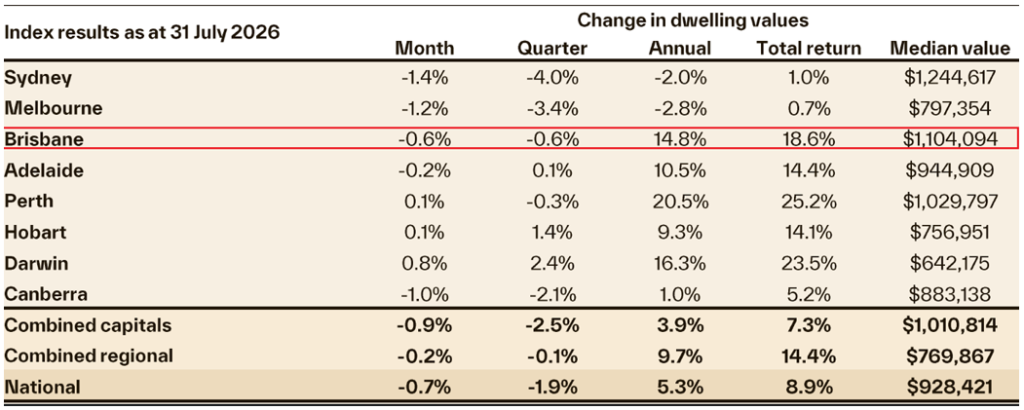
Brisbane’s property market moved into negative territory through July 2026, with Cotality’s Home Value Index recording a 0.6% fall in dwelling values over the month. This was the clearest signal yet that the slowdown building since the Federal Budget has become a genuine downturn rather than a loss of momentum.
Brisbane was far from alone. Nationally, the Cotality index fell 0.7% in July, the largest single-month decline since December 2022, while combined capital city values fell 0.9% over the month and 2.5% across the quarter. Sydney (-1.4%) and Melbourne (-1.2%) continued to lead the national decline, with Canberra (-1.0%) close behind and Adelaide slipping 0.2%. Only Darwin (0.8%), Perth (0.1%) and Hobart (0.1%) recorded gains. What was previously a two-city story has now spread across almost every capital city market.
Over the quarter, Brisbane values are down 0.6%, a far shallower decline than the 4.0% fall in Sydney, 3.4% in Melbourne or 2.1% in Canberra. On an annual basis Brisbane remains one of the strongest performers in the country, up 14.8% and trailing only Perth (20.5%) and Darwin (16.3%). Across the past decade Brisbane dwelling values have risen 116.6%, still the highest rate of growth of any capital city market in Australia.
Demand-side factors have all pulled in the same direction. Affordability and mortgage serviceability constraints that emerged late last year, three cash rate rises so far in 2026 that have lifted the cash rate to 4.35%, higher fuel costs and deeply pessimistic consumer confidence following the Iran conflict and the policy changes coming out of the Budget have collectively reduced both borrowing capacity and buyer willingness to act.
Sellers have been slower to adjust. Median days on market across Brisbane have lengthened to 23 days, three days longer than a month ago, and sales volumes are now 0.7% lower over the past twelve months. The consequence is that total advertised listings have climbed 23.2% over the year, a substantial acceleration from the 13.6% annual increase recorded in June, as older stock accumulates rather than clears.
New listings tell the opposite story. New listings are only 0.8% higher than a year ago, down sharply from the 11% annual growth reported last month, and are now falling on a month-on-month basis. Vendors without a pressing reason to sell are choosing to wait for conditions to improve rather than test a nervous market.
There remains a considerable mismatch between buyers who assume prices have already fallen a long way and sellers whose expectations remain somewhat firm despite the shift in sentiment. Auction clearance rates across Brisbane fell well below June levels. Consumer sentiment is still deeply pessimistic, although the Westpac-Melbourne Institute index rose 4.1% over the month to reach 83.9 index points. Sentiment remains 9.9% lower than a year ago, with easing pressure on fuel prices and reduced concern about further rate hikes cited as the reasons behind the improvement.
Brisbane Dwelling Values
Brisbane dwelling values fell 0.6% in July according to Cotality, a swing of 0.8 percentage points from the 0.2% gain initially reported for June. The median dwelling value now sits at $1,104,094, down from $1,118,306 a month earlier. Quarterly growth has moved into negative territory at -0.6%, reversing the 1.3% gain recorded in the previous reading, while annual growth has eased to 14.8% from 17.4%. PropTrack data showed a similar trend, with Brisbane dwelling prices down 0.3% over July and annual growth of 11.1%.
Source: Cotality
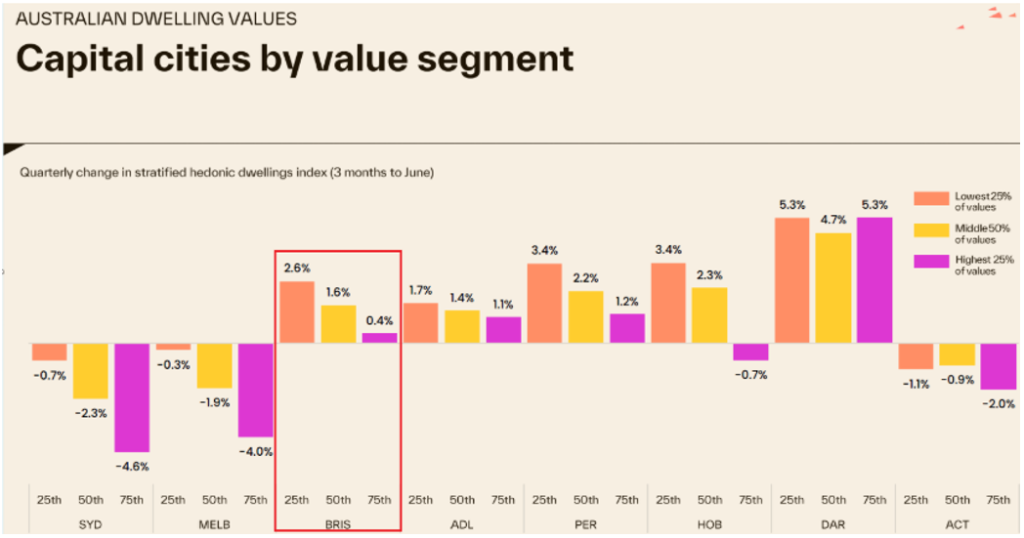
The stratified data confirms the softening is broad based but uneven. Over the three months to June, growth across Brisbane’s lowest quartile eased to 2.6% from 4.8% in the previous reading, the middle 50% of the market slowed to 1.6% from 3.9%, and the upper quartile softened to just 0.4% from 2.2%. More affordable price points continue to lead, and the pattern is consistent nationally, where upper-quartile values fell 3.2% over the three months to July compared with a 0.3% gain across the lower price tier. The correction is clearly weighted towards higher-value property.
Source: Cotality
Brisbane House Values
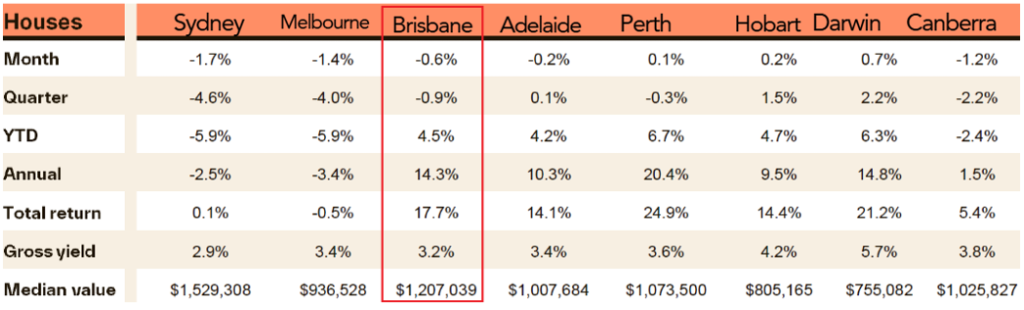
Brisbane house values fell 0.6% in July according to Cotality, with the median house value now $1,207,039, down from $1,225,350 in June. Quarterly growth has turned negative at -0.9%, from 1.1% a month earlier, while annual growth has eased to 14.3% from 16.8%. PropTrack data showed a similar result, recording a 0.3% monthly fall in Brisbane house prices through July with annual growth of 9.7%. Brisbane houses nonetheless remain more expensive than in any capital other than Sydney.
Source: Cotality
Brisbane Unit Values
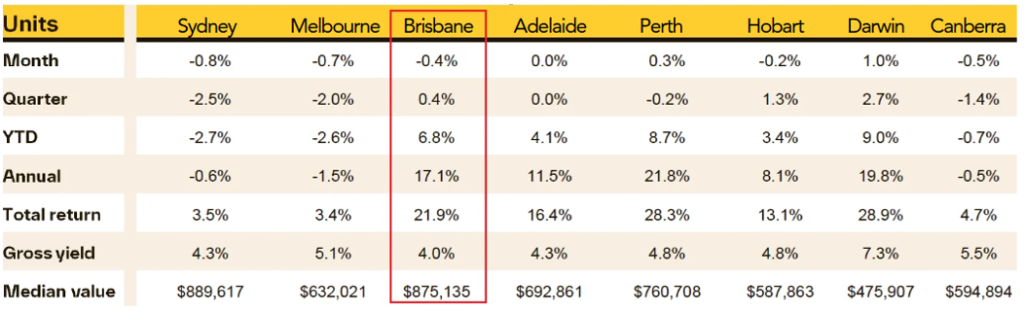
Brisbane’s unit market again held up better than houses. Unit values fell 0.4% in July to a median of $875,135, down from $885,132 in June. Units were the only Brisbane segment still positive over the quarter, up 0.4%, although this was well down on the 2.2% recorded a month ago. Annual growth eased to 17.1% from 20.3%, still the strongest of any dwelling type in the city and materially ahead of the 14.3% recorded for houses. PropTrack showed a similar trend with a monthly fall of 0.2% and annual growth of 15.2%. This relative strength continues to reflect affordability-driven demand at a time when borrowing capacity is constrained.
Source: Cotality
Brisbane’s Rental Market
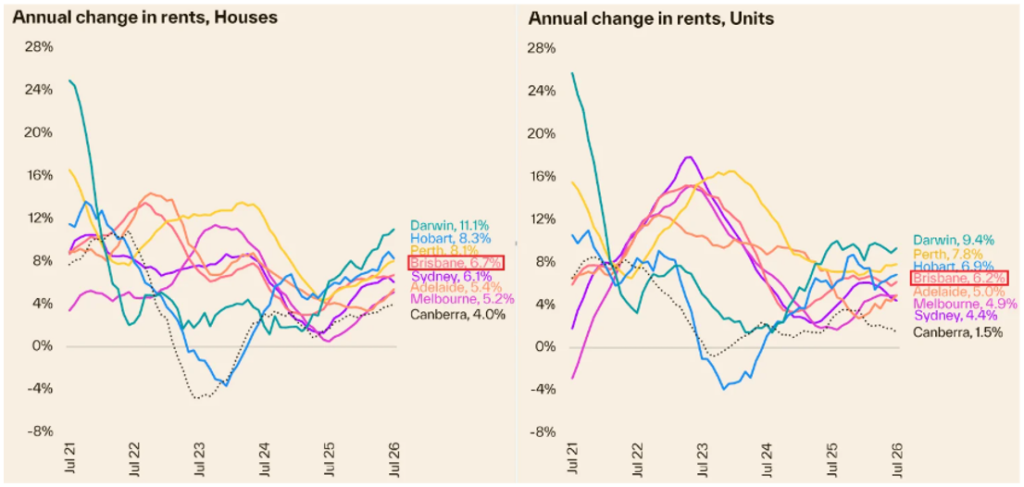
In contrast to values, Brisbane’s rental market is showing renewed pressure. The vacancy rate across Greater Brisbane remained at 0.9% in July, unchanged from the previous month and well below the national vacancy rate of 1.7% and its ten-year average of 2.4%. Annual house rent growth lifted slightly to 6.7% from 6.6%, while annual unit rent growth accelerated more noticeably to 6.2% from 5.8%. Both measures remain comfortably ahead of inflation and above the national rental growth rate of 5.9%.
Gross rental yields improved for investors over the month. Houses in Greater Brisbane now return 3.2%, up from 3.1% in June, while units returned 4.0%, up from 3.9%. This improvement reflects rents rising while values fall rather than any structural change in returns. With borrowing costs above 6% and the May Federal Budget’s negative gearing changes having shifted the calculus for investors, yield gains of this magnitude are unlikely on their own to draw investors back to established stock.
Source: Cotality
Summary
Brisbane may see further softening over the coming months, however a number of factors reduce the risk of a sharp correction. Unemployment remains low, supporting housing demand and reducing the risk of forced sales, while population growth continues to provide fundamental underpinning for demand. Brisbane also has approximately $10.3 billion of infrastructure investment, $8 billion of commercial development and $2.8 billion of residential development underway. This investment should support employment, improve accessibility and reinforce demand in suburbs benefiting directly from new transport, services and amenity.
On the supply side, high construction costs and challenges regarding project feasibility remain a constraint to new homes, while vendors appear to be pulling back from the market. Together, these responses could start to limit some of the downward pressure on values.
Well-located established houses should continue to attract a scarcity premium. While the broader development pipeline is valued at approximately $22.7 billion, it is heavily weighted towards infrastructure, commercial projects, units and residential land rather than completed detached houses. Established family homes close to employment, transport, schools and lifestyle amenities are therefore unlikely to become materially easier to replace.
Brisbane will also become an increasingly fragmented market and should not be assessed as one uniform market. The most probable outcome is not another period of uniform rapid growth, but more selective performance in which high-quality property continues to outperform.
July 2026 marks the point at which Brisbane’s slowdown became a decline, with values falling, listings accumulating and buyers holding back. Yet the fundamentals that underpinned the past decade of growth have not disappeared. Housing construction is not keeping pace with demand, rental vacancies remain exceptionally low, and substantial infrastructure investment continues across the city. Reported medians may soften further, and owners who are not currently selling should read this as a shift in what is transacting rather than a like-for-like fall in the value of their own property. For prepared buyers with secure employment and sufficient borrowing capacity, the combination of more stock, longer decision-making timeframes and stronger negotiating conditions represents an opportunity that is unlikely to persist once confidence returns.
We hope that you have found our Brisbane Property Market Update July 2026 helpful.
Connect with us today
To book a FREE discovery call ~ Click Here
