
By Melinda Jennison
Introduction
Brisbane’s property market continued to record positive value growth through May 2026, yet the landscape has shifted noticeably since the start of the year. Growth is moderating, buyer sentiment has softened in the wake of major federal budget announcements, and the RBA’s decision to lift the cash rate by a further 25 basis points in May, fully reversing the three cuts delivered throughout 2025, has amplified an already cautious mood. Against this backdrop, Brisbane remains one of Australia’s strongest-performing capital cities, though the pace and breadth of that performance are becoming more uneven.
The federal budget’s proposed changes to housing investment tax settings, centred on limiting negative gearing to new builds from 1 July 2027 and replacing the 50% CGT discount with an indexed cost base approach, have had an immediate and material effect on buyer sentiment. The associated media response has been quite overwhelming for many buyers who were on the cusp of acting, and the uncertainty is prompting a wide pause across both owner-occupier and investor segments. Buyers were already navigating a challenging environment with successive cash rate increases, volatile global markets, and ongoing instability in the Middle East.
Throughout the month, headline inflation did ease to 4.2, which is an encouraging development and arguably reduces some of the urgency for the RBA to lift rates again in the near term. Nonetheless, inflation remains elevated and the risks remain tilted more in favour of higher interest rates than lower ones, particularly if conflict in the Middle East continues and oil price pressures persist.
For investors, the budget announcements represent a fundamental reassessment of strategy. Demand in Brisbane for established houses and units has dropped sharply as investors pause to reconsider their positions. Those who purchase investment properties going forward will have the choice to buy newly constructed property and retain access to negative gearing, or to purchase existing property and accept that any rental losses can only be offset against rental income, with losses carried forward rather than deducted from other income. In practice, this means that only wealthier investors, those with the capacity to absorb ongoing losses or who can utilise more tax-effective ownership structures, are likely to remain active buyers in the established property space in the near term. Of course, none of this has yet been legislated, and many market participants are wisely waiting for certainty before making decisions involving such significant capital commitments.
There is a silver lining for first home buyers who have already saved for a deposit to buy in Brisbane. Making established housing less attractive to investors affords owner-occupiers a little more breathing room and reduced competition at the entry end of the market.
Brisbane’s established market continues to draw a broad mix of buyers, including first home buyers, upgraders, and downsizers, so outcomes on the ground are decidedly mixed following budget night. Some open homes remain well attended, with properties selling quickly under multiple offers. Others are seeing subdued attendance and extended days on market, a divergence that is likely to show up more clearly in the data over coming months. Auction clearance rates fell sharply across May, averaging just 48.5%, down from 55.18% in April and 56.3% a year ago, reflecting the growing gap between vendor price expectations and buyer willingness to commit.
New listing volumes also increased significantly, rising 35.4% over the past 12 months. While this brings more choice for buyers, total listings across Brisbane declined by 0.9% over the same period, suggesting the market continues to absorb supply relatively effectively, though this balance bears close monitoring as absorption rates slow. Quality properties in highly regarded locations continue to transact well, but where there is a disconnect between vendor expectations and buyer pricing, properties are sitting on the market considerably longer. Median days on market in Brisbane currently stand at 18 days, one day faster than the previous month, though this figure is expected to trend higher as urgency wanes.
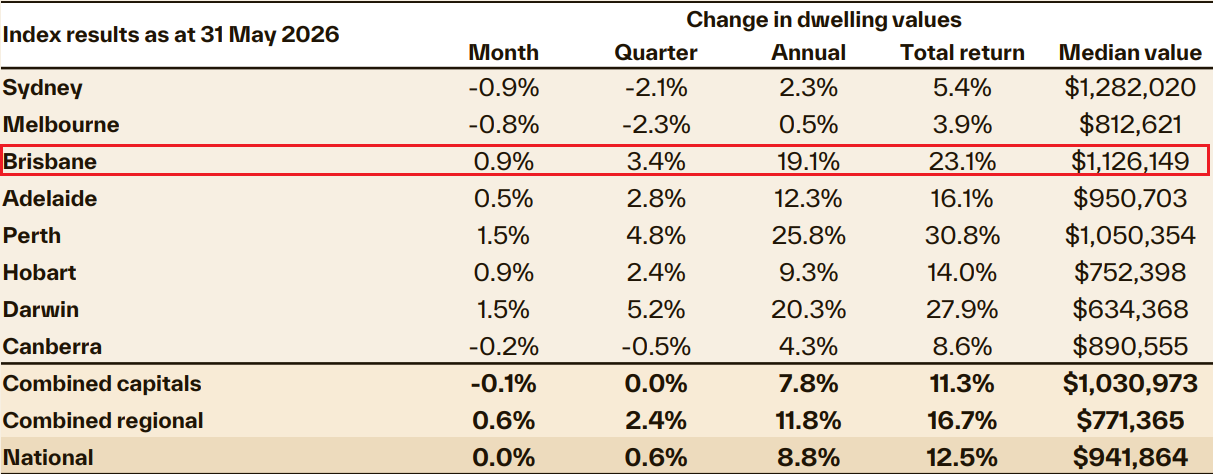
Nationally, the picture is one of increasing divergence. Sydney and Melbourne are leading a softening cycle, with dwelling values falling 0.9% and 0.8% respectively in May, now sitting 2.1% and 2.9% below their cyclical peaks reached in November 2025. Canberra also recorded a decline of 0.2% over the month. By contrast, Perth and Darwin each surged 1.5%, followed by Brisbane and Hobart at 0.9% and Adelaide at 0.5%.
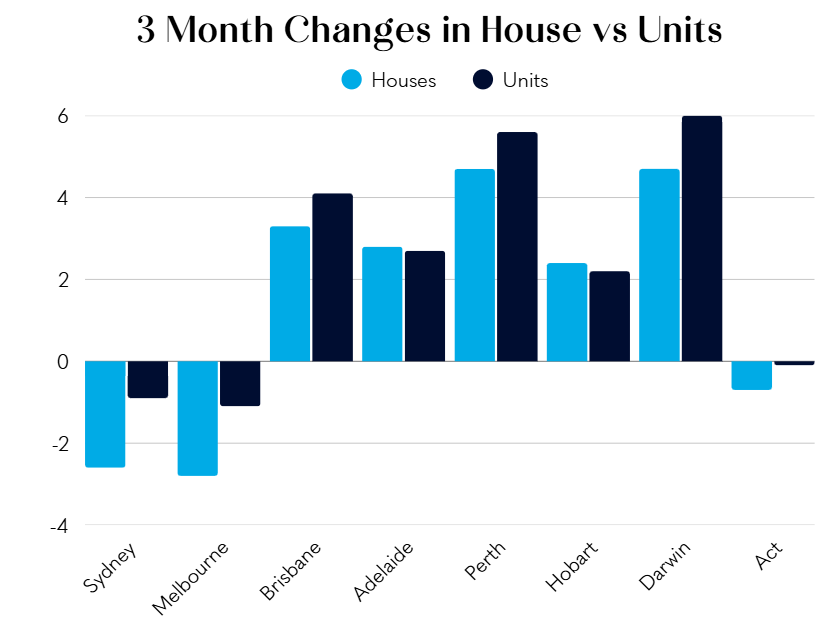
Source: Cotality
Over the past 12 months, Brisbane’s 19.1% annual growth in dwelling values stands well above the national average of 8.8% and outpaces most other capitals but for Perth (25.8%) and Darwin (20.3%). On a five-year view, Brisbane has delivered 80.6% growth, and over a decade, 120.2%, which is the highest of any capital city market in Australia. The national index was flat in May, underscoring just how divided Australian housing conditions have become.
Brisbane Dwelling Values
Brisbane dwelling values rose 0.9% in May 2026, according to Cotality data, bringing the median dwelling value to $1,126,149. This represents a moderation from the 1.2% monthly growth recorded in April. Over the past quarter, dwelling values have increased by 3.4%, easing from the 4.7% quarterly growth of the prior month. On an annual basis, Brisbane dwellings have risen 19.1%, a figure that remains among the strongest across Australia’s capital cities and confirms the city’s sustained outperformance.
Source: Cotality
PropTrack data follows this trend, reporting positive monthly dwelling price growth of 0.1% throughout May, consistent with the direction shown in Cotality’s figures.
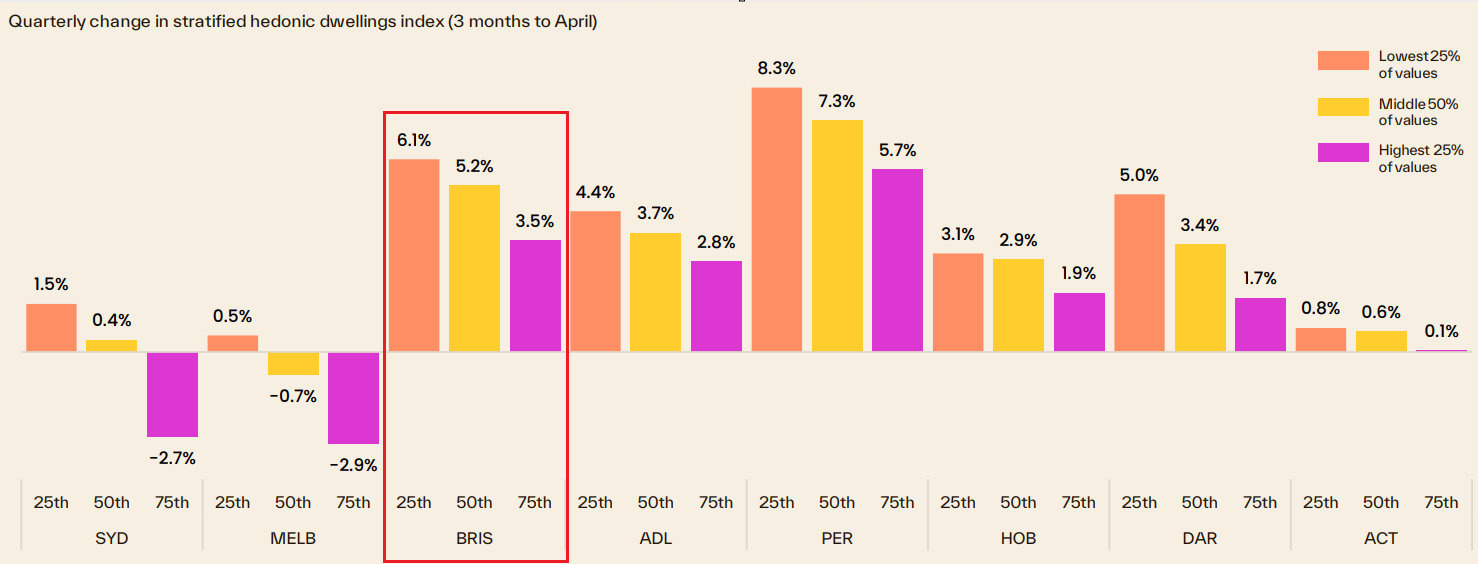
Examining the Brisbane market by value segment provides important context. The quarterly change data shows that across Brisbane’s stratified price tiers, the lower quartile recorded quarterly growth of 6.1%, the middle segment 5.2%, and the upper quartile 3.5% in the three months to April. This indicates that more affordable price points continue to attract the broadest buyer demand, a pattern consistent with national trends.
Source: Cotality
Brisbane House Values
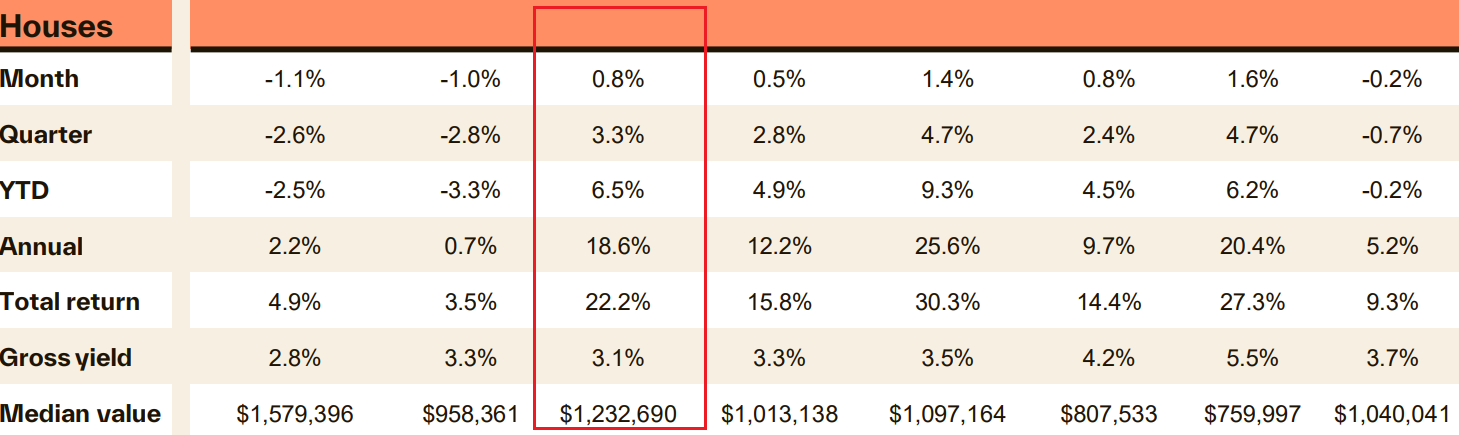
Brisbane house values rose 0.8% in May 2026, with the median house value now at $1,232,690. This follows the 1.2% monthly gain recorded in April and continues a sustained period of positive price growth, though at a moderating pace. On a quarterly basis, house values increased 3.3%, compared with 4.5% over the equivalent period the previous month, while the annual growth rate of 18.6% eases slightly from the 19.1% recorded in April.
Source: Cotality
PropTrack data reports 0.1% house price growth across Brisbane in May, consistent with the positive growth trend confirmed by Cotality.
Brisbane Unit Values
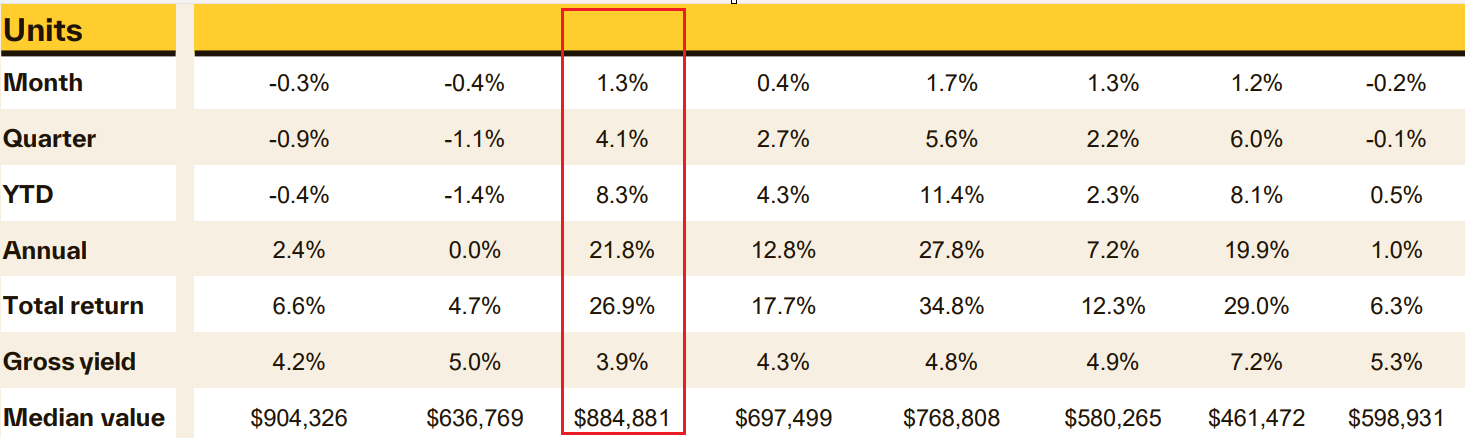
Brisbane’s unit market again outperformed houses in May, with values rising 1.3% to a median of $884,881. This was slightly below April’s 1.4% increase but still reflects strong monthly growth. Quarterly unit values rose 4.1%, down from 5.5% the previous month, while annual growth reached 21.8%, the strongest of any dwelling type in Brisbane, highlighting sustained demand from buyers priced out of the house market.
Source: Cotality
PropTrack data reports 0.1% unit price growth across Brisbane in May, which is consistent with the positive trend recorded by Cotality.
Brisbane’s Rental Market
Brisbane’s rental market remains extremely tight. The vacancy rate for Greater Brisbane held steady at 0.8% in April, a figure that underscores the severity of the rental supply shortage and continues to place upward pressure on rents. Nationally, the vacancy rate dipped to 1.5% in May, in line with the record lows recorded in 2022 and 2023 when overseas migration drove a sharp tightening of rental stock.
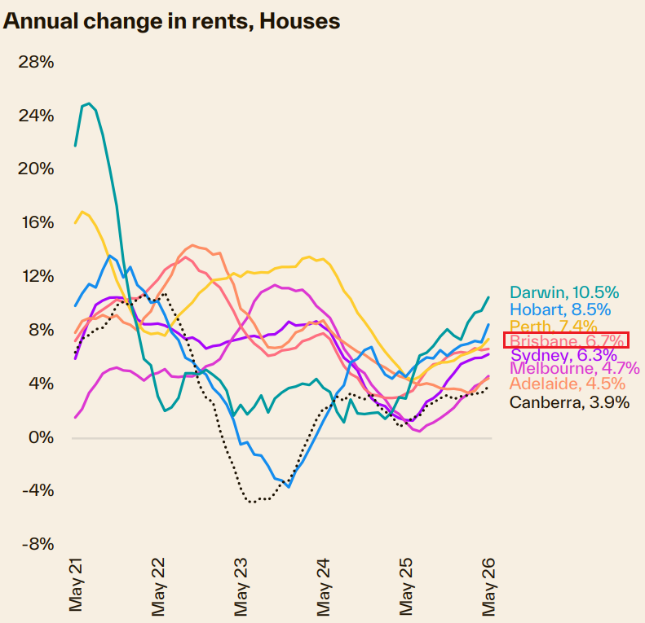
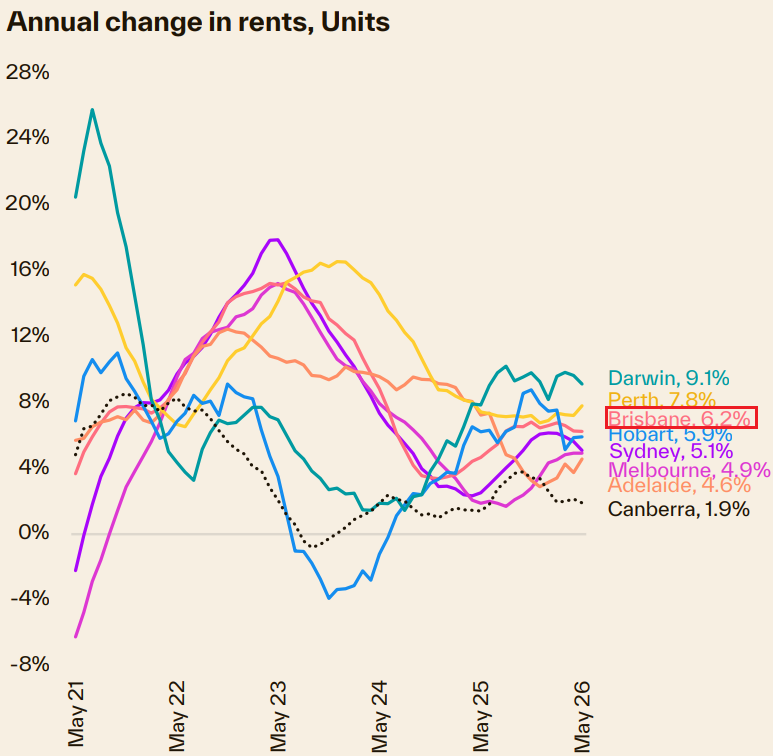
In Brisbane, annual house rent growth reached 6.7% in May, up from 6.5% in April, continuing a reacceleration trend that has been building since mid-2025. Annual unit rent growth came in at 6.2% in May, a modest easing from the 6.4% recorded in April. Both figures remain well above the rate of inflation and continue to represent a significant financial burden for Brisbane renters.
 Source: Cotality |
 Source: Cotality |
Gross rental yields for investors remain at 3.1% for houses and 3.9% for units, both unchanged from the prior month.
Summary
May 2026 marks a genuine inflection point for the Brisbane property market. Values continue to rise, and Brisbane remains among Australia’s strongest-performing capital cities by virtually every metric, but the environment is undeniably more complex than it was at the start of the year. The combination of the RBA’s rate hike returning the cash rate to its cyclical high of 4.35%, federal budget changes reshaping investor incentives, and mounting affordability pressures has produced a market that is simultaneously robust in its fundamentals yet increasingly cautious in its sentiment.
While the latest round of rate movements, ongoing geopolitical uncertainty and political headwinds are creating some softness across the city, a fundamental undersupply continues to underpin the market. Layered on top of this are comprehensive new infrastructure programmes, strong population inflows, and the lead-up to the 2032 Olympic Games, all of which point toward continued medium to long-term upside.
The key message is not that demand has disappeared. Rather, demand has become more selective. Quality properties in strong locations are still selling well. Properties with pricing issues, location compromises or limited buyer appeal are more likely to sit for longer.
Brisbane is, of course, not a single market. It is made up of many distinct micro-markets, each influenced by its own demand drivers, buyer profiles and price movements.
Across Brisbane’s diverse sub-markets, the overarching narrative remains one of constrained supply meeting resilient, population-driven demand. The fundamentals that have supported price growth over the past several years – undersupply, migration, infrastructure investment, and the Olympic-led stimulus – have not meaningfully shifted. That said, buyers are becoming more discerning.
Caution is warranted around new house-and-land packages and off-the-plan product, while established property continues to offer better relative value in most cases. For buyers and investors operating across any of Brisbane’s sub-markets, the consistent theme is selectivity. Asset quality, location fundamentals, and an honest assessment of cost versus value remain the key levers to navigate what promises to be a more nuanced second half of 2026.
We hope that you have found our Brisbane Property Market Update May 2026 helpful.
Connect with us today
To book a FREE discovery call ~ Click Here
