
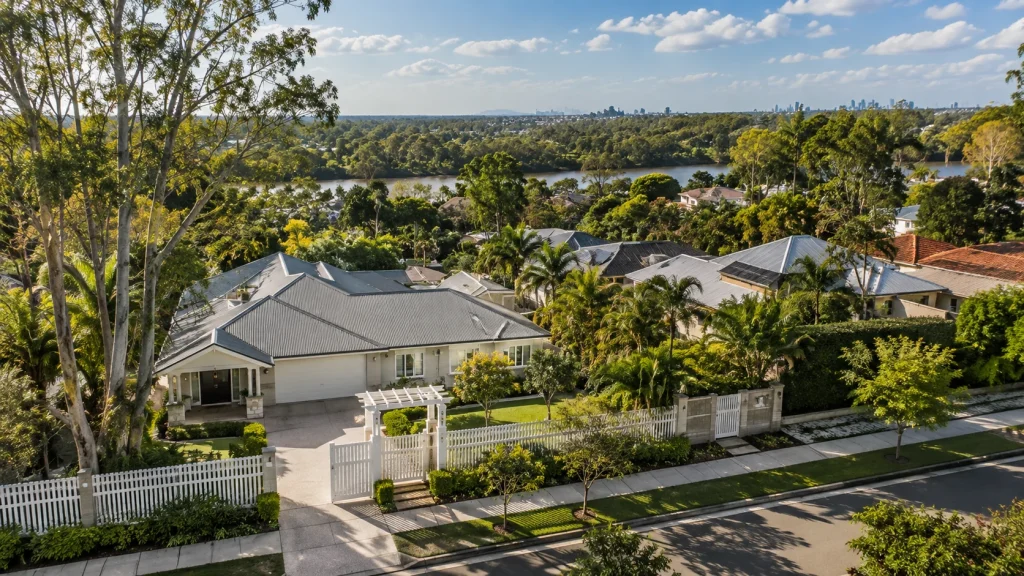
If you’re weighing up Fig Tree Pocket real estate, you’re looking at one of Brisbane’s most established riverside pockets. Bordered by the Brisbane River and sitting close to Seventeen Mile Rocks, Chapel Hill, and Kenmore, this Fig Tree Pocket suburb profile pulls together the current data, from prices and rental yield to schools and demographics, helping home buyers, investors, and those considering commercial properties assess whether the suburb aligns with their property goals.
Key Takeaways
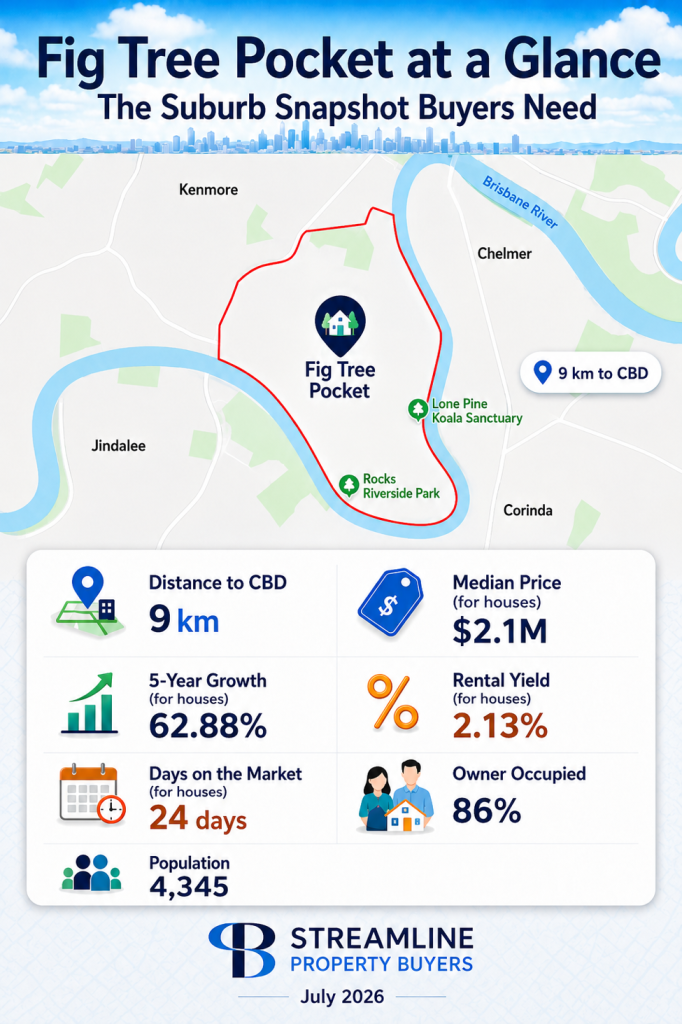
Fig Tree Pocket sits about 9km from the Brisbane CBD, wrapped by the river and neighbouring Seventeen Mile Rocks and Chapel Hill. The median house price is $2,150,000, and that figure has climbed 18.75% in the past 12 months alone (July 2026), with houses typically selling within 24 days.
A few things stand out if you’re short on time:
- Household income here runs high, a median of $4,228 a week, well ahead of the Brisbane average
- The population reached 4,345 at the 2021 Census, and 86% of residents own the home they live in
- This is very much a house suburb. Roughly 99% of dwellings are standalone houses, so unit buyers will need to look elsewhere
- Three schools serve the area, including Fig Tree Pocket State School, plus 5 child care centres
- On the investment side, vacancy sits at just 1.97% and buyer demand has stayed consistently strong, though gross rental yield for houses is a more modest 2.13%
Geography
Fig Tree Pocket covers 4.28 square kilometres of land wrapped by a bend in the Brisbane River, roughly 9km west of the CBD. It shares borders with Kenmore, Chelmer, Corinda, and Seventeen Mile Rocks, with the Centenary Highway running along its western edge providing a direct link toward the city and the western corridor.
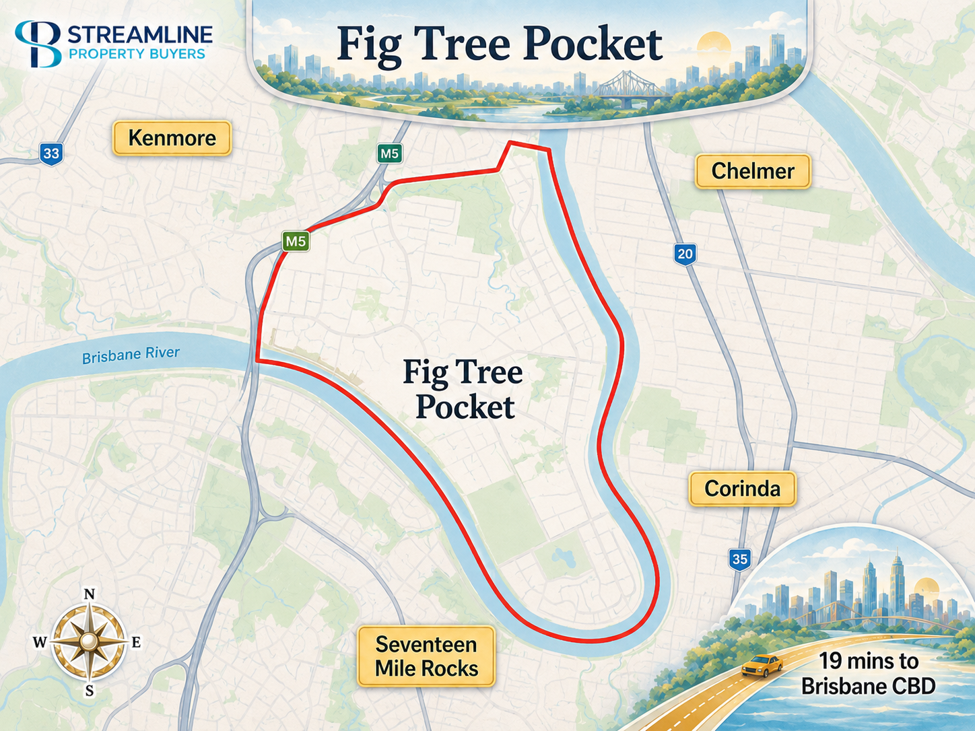
The suburb’s most recognisable landmark is the Lone Pine Koala Sanctuary, which sits on the riverbank and draws visitors from across Brisbane. The area also has a low crime score of just 10 out of 100, which typically points to a quieter, family-oriented community.
Properties near the water carry a flood consideration worth flagging early. Given the river forms much of the suburb’s northern and eastern boundary, always check a specific address against the Brisbane City Council flood awareness map before you get too far into a purchase.
Transport
Fig Tree Pocket doesn’t have a train station within its borders, so residents rely mainly on car and bus travel. The Centenary Highway runs along the suburb’s western edge, giving quick access toward Kenmore, Indooroopilly, and the wider western corridor, and connecting through to the CBD.
Local bus routes link the suburb to Chapel Hill, Kenmore, and Indooroopilly, where commuters can pick up train services on the Ipswich or Springfield lines for the trip into the city. For those who prefer active transport, the riverside setting also supports walking and cycling along the Brisbane River, though there’s no dedicated CityCat stop within the suburb itself.
For current timetables and route planning, visit translink.com.au.
Education
Child Care Centres
Child Care Centres
There are 5 child care and early learning centres within Fig Tree Pocket:
| Centre / Operator | Address |
| Brisbane Montessori Outside School Hours Care | 12 Mactier Street, Fig Tree Pocket Road |
| Brisbane Montessori School – Programmes | 12 Mactier Street |
| Fig Tree Pocket Early Childhood Centre | 233 Fig Tree Pocket Road |
| Fig Tree Pocket Outside School Hours Care | 78 Cubberla Street |
| Gan Gani Kindergarten | 691-695 Fig Tree Pocket Road |
Schools
There are 3 schools located within the suburb itself:
| School | Type | Sector |
| Fig Tree Pocket State School | Primary | Government |
| Brisbane Montessori School | Combined | Non-Government |
| Mancel College | – | Non-Government |
Having a government primary school within the suburb tends to support stable, long-term tenancies, since families with children attending the local school are less likely to move on quickly. Always verify current catchment boundaries directly with the Queensland Government school catchment tool before purchasing, as these can shift over time.
Amenities and Lifestyle
Fig Tree Pocket has a genuinely leafy, riverside feel that’s rare this close to the CBD. The Lone Pine Koala Sanctuary anchors the suburb’s identity, and nearby Coles at Sinnamon Park covers everyday shopping needs. White Lies Brewing and Distillery, just south of the suburb, adds a local dining and drinking option without needing to head into the city.
The Brisbane River frames the suburb’s northern and eastern edges, offering walking and cycling paths along the water for residents who want green space without leaving home. For buyers who value river access, established gardens, and a quieter pace while still being a manageable drive from the CBD, this is one of the suburb’s clearest selling points.
What Properties Are Available in Fig Tree Pocket?
Family homes on established blocks are what you’ll mostly find here, with separate houses making up close to 99% of the suburb’s dwellings. Listings run from older established homes through to newer builds, and the median house price currently sits at $2,150,000.
If a unit is what you’re after, you’ll have better luck in Kenmore or Chapel Hill next door, where stock is more available and entry prices tend to be friendlier. Fig Tree Pocket suits buyers looking for space, privacy, and a family-sized block rather than low-maintenance apartment living.
Is Fig Tree Pocket a Good Suburb to Invest In?
Fig Tree Pocket’s Property Market Performance
The data points to a suburb that’s performed strongly over the past year, though it’s worth reading the figures in context rather than in isolation.
| Metric | Houses |
| Median Price | $2,150,000 |
| 3-Month Change | 3.37% (+$70,000) |
| 12-Month Change | 18.75% (+$339,500) |
| 3-Year Change | 44.78% (+$665,000) |
| 5-Year Change | 62.88% (+$830,000) |
| 5-Year Annual Growth (CAGR) | 10.25% |
| 10-Year Annual Growth (CAGR) | 7.99% |
| 30-Year Annual Growth (CAGR) | 8.35% |
There’s no reliable unit data for Fig Tree Pocket, which reflects the suburb’s house-dominant makeup. Over a 30-year horizon, annual growth has averaged 8.35%, suggesting this is a suburb that has historically held its value well across different market cycles. That said, past performance is not a guarantee of what happens next, and buyers should weigh current conditions on their own merits.
Days on Market
Sales days on market show how quickly buyers are competing for what’s available. Houses in Fig Tree Pocket are currently selling in 24 days, well inside the 90-day benchmark that typically signals healthy buyer demand. That figure has also improved by 42.86% over the past 12 months, meaning properties are moving faster than they were a year ago.
Rental Yield
| Metric | Houses |
| Median Rent (per week) | $880 |
| Gross Rental Yield | 2.13% |
| Vacancy Rate | 1.97% |
A vacancy rate below 2% typically points to strong rental demand relative to supply, and Fig Tree Pocket’s 1.97% sits comfortably in that range. The trade-off is a rental yield of 2.13%, which is on the lower side and reflects the premium entry price point rather than weak rental demand. This is a common pattern in established, high-value suburbs: strong capital growth tends to come at the cost of cash flow.
Key Investment Signals at a Glance
- Vacancy has sat at just 1.97%, which points to rental demand well ahead of what’s available
- Stock on market is 1.32%, comfortably under the 2% mark that usually signals a tight supply of listings
- Buyer demand is rated “High Online Demand” by SuburbsFinder, and it’s grown 22.13% over the past three years
- At $4,228 a week, median household income here ranks among the highest in Brisbane
- SEIFA scores have sat at the top of the scale in every census since 2006, a sign of consistently high socio-economic advantage
- Public and community housing accounts for just 1.67% of dwellings, a negligible share
In my experience, suburbs with this combination of low vacancy, tight stock on market, and high household income tend to attract consistent buyer interest, even when broader market sentiment shifts.
Demographics
At the 2021 Census, Fig Tree Pocket had a population of 4,345, up from 3,259 in 2006. Median weekly household income sat at $3,791 in 2021, a significant jump from $2,115 in 2006, and current data puts that figure at $4,228. Owner-occupier rates have held steady at 86% since 2006, which is a strong indicator of residential stability rather than a suburb driven by short-term rental turnover.
Professionals make up 42% of the workforce, followed by managers at 22% and clerical and administrative workers at 11%. Hospitals, higher education, and computer system design are the leading industries locally, which fits with a suburb full of professionals working within easy reach along the Centenary corridor and into the CBD.
Key Demographics Over Time
| 2006 | 2011 | 2016 | 2021 | |
| Population | 3,259 | 3,652 | 4,045 | 4,345 |
| Median Weekly Household Income | $2,115 | $2,710 | $3,038 | $3,791 |
| Median Monthly Mortgage Repayments | $1,950 | $2,600 | $2,815 | $3,033 |
| % Owner Occupier | 85% | 86% | 86% | 86% |
| % Renter | 15% | 14% | 14% | 14% |
| Total Dwellings | 1,104 | 1,185 | 1,370 | 1,439 |
| Avg. People per Household | 3.1 | 3.2 | 3.1 | 3.2 |
What Are the Best Streets and Pockets in Fig Tree Pocket?
Fig Tree Pocket isn’t formally divided into distinct precincts the way some suburbs are, but its layout still creates a few clear pockets worth understanding before you buy.
| Area | Streets / Pockets | Why |
| Riverfront pockets | Streets near Jesmond Road and the Brisbane River frontage | River outlook and established gardens, but flood overlay check required |
| Centenary Highway corridor | Streets near Kersley Road and the highway edge | Fast access to Kenmore and the CBD, though road noise is worth factoring in |
| School and childcare precinct | Streets around Fig Tree Pocket Road and Cubberla Street | Walking distance to the state school, childcare centres, and local shops |
| Quieter interior streets | Norman Street, Thiesfield Street, and Spinkbrae Street surrounds | Family-friendly, set back from the highway and main tourist routes |
The riverfront pockets tend to attract the strongest long-term interest given the outlook and land size, while streets closer to the school and childcare precinct suit buyers prioritising walkability and rental stability. Always verify a specific address against council mapping before making assumptions about any pocket.
Buyers Agent Fig Tree Pocket: What to Check Before You Buy
Before making an offer on any property in Fig Tree Pocket, work through this checklist:
- Flood overlay check: Verify the specific address via the Brisbane City Council flood awareness map, given the river forms much of the suburb’s boundary.
- Property type alignment: Confirm a house suits your goals, since units and townhouses make up almost none of the local market.
- School catchment verification: Confirm your preferred catchment via the Queensland Government school catchment tool, particularly for Fig Tree Pocket State School.
- Development activity nearby: There have been 33 recent development applications in the suburb, mostly reconfiguring lots and smaller building works, so check what’s happening near the street you’re considering.
- Road noise exposure: Properties closer to the Centenary Highway can pick up more traffic noise than those set back toward the river.
- Transport access: Confirm bus route frequency and connections toward Kenmore and Indooroopilly at translink.com.au.
How Streamline Property Buyers Gives You an Edge in Fig Tree Pocket’s Market
Fig Tree Pocket is a suburb where the right property, at the right price, doesn’t sit on the market long, houses are currently selling in just 24 days on average. With such a house-dominant market and strong owner-occupier demand, understanding which pocket and property type suit your goals can make a meaningful difference to your outcome.
At Streamline Property Buyers, we work exclusively for buyers across Brisbane. We access both on-market and off-market opportunities, negotiate on your behalf, and handle the due diligence that protects your position. If you’re considering a purchase in Fig Tree Pocket QLD as a home buyer or investor, get in touch with our team for tailored insights into this market.
Fig Tree Pocket QLD 4069 | Data as at July 2026
Property data sourced from SuburbsFinder Ltd (ABN 34 687 487 921) on behalf of PropTrack Pty Ltd (ABN 43 127 386 298), July 2026. Demographics data from the Australian Bureau of Statistics, 2021 Census. This profile is provided for general information purposes only and does not constitute financial, investment, or legal advice. Past performance is not indicative of future results. Buyers should conduct their own independent due diligence before making property decisions.
Connect with us today
To book a FREE discovery call ~ Click Here
Follow us on LinkedIn | YouTube | Instagram | TikTok
Tune into our podcast ~ Brisbane Property Podcast
